


 732
732Digital photomicrography with the Euromex NexiusZoom EVO stereo microscope: Enhancing image quality with today’s advanced digital cameras
The Euromex NexiusZoom EVO is a Greenough-type stereo microscope with a zoom ratio of 8.4:1. This optical system uses two separate optical paths to produce a three-dimensional (stereoscopic) view of the specimen. To transfer this optical quality into digital image data without data loss, our LM microscope adapters provide a professional interface between the microscope and today’s state-of-the-art camera technology.
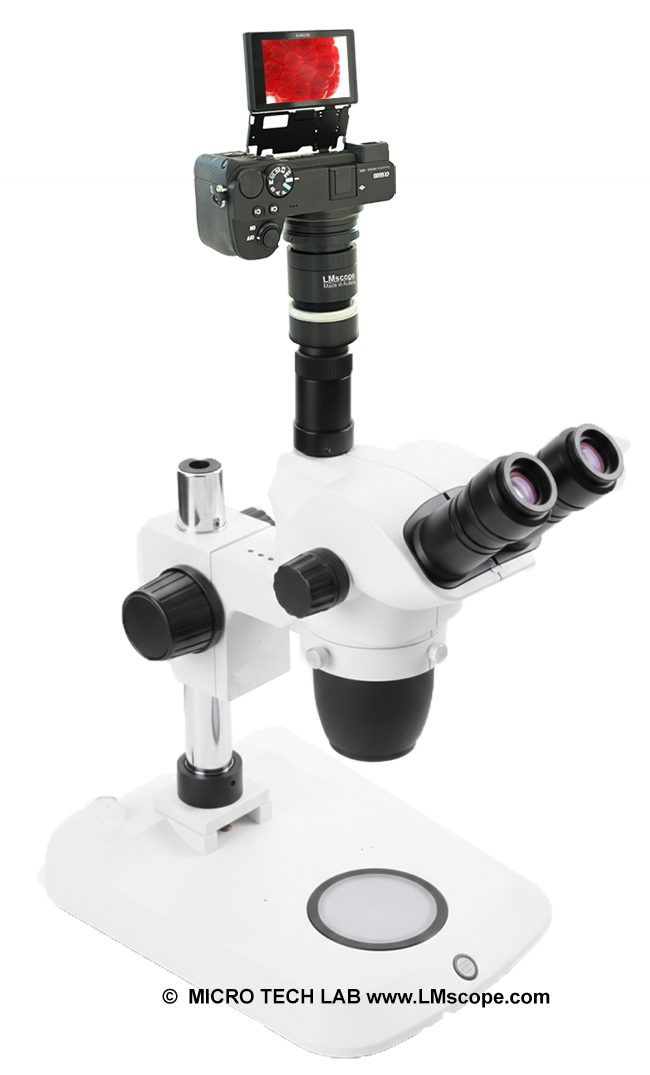
In the lineup of Euromex microscopes, the NexiusZoom EVO is positioned as an entry- to mid-level system for industrial inspection tasks, laboratory applications and educational environments. Developed as the next generation of the original NexiusZoom introduced in 2012/2013, the EVO version delivers an expanded zoom range and higher resolving power.
To fully unlock the capabilities of this microscope, selecting the right camera interface is essential. Our LM microscope adapters with integrated precision optics allow you to take advantage of today’s most powerful digital cameras. Depending on your specific application and requirements, you can use the camera system that optimally meets your imaging needs.
Stereo microscopes are most commonly used at magnifications of up to approx. 50x. For this magnification range, we recommend combining high-quality stereo microscopes or macroscopes with powerful full-frame cameras that deliver 30–60 megapixels, such as the latest mirrorless system cameras (DSLMs), hybrid cameras or digital single-lens reflex cameras (DSLRs) equipped with large image sensors.
Key advantages of these cameras:
- When working at lower magnifications, the higher number of pixels brings out fine specimen details and subtle microstructures with increased clarity and precision.
- The large sensor format delivers outstanding dynamic range and excellent light sensitivity.
- As a rule, these cameras can be conveniently controlled from a computer, tablet or smartphone in Live View. Even without a computer, the live image can typically be displayed in high quality at 4K or 8K resolution on an external monitor via HDMI cable, which makes these cameras an excellent choice for live presentations.
- In addition to still photography, modern digital cameras also support high-resolution video recording (Ultra HD, 4K and 8K).
- As they are produced in large quantities, they are available at highly competitive prices. However, camera models that are a few years older and therefore more affordable also deliver excellent image quality in microscopy applications.
- For more information on making a camera selection, please see our camera info page.
For specialised imaging requirements, our adapter solutions with integrated precision optics also support special-purpose microscope cameras, C-mount microscope cameras, industrial C-mount cameras, compact cameras, Ultra HD camcorders, medium format system cameras and high-speed cameras.
The result is a highly flexible imaging solution that allows you to significantly improve image quality and workflow efficiency while keeping costs down.
Key features of the NexiusZoom EVO:
- Finite-corrected stereo microscope with a Greenough optical system (two fully independent optical paths located at a certain angle to each other)
- Imaging methods: brightfield, darkfield, polarisation
- Plan achromatic zoom objectives
- Zoom ratio: 8.4:1
- Magnification range: 6.5x–55x (with click stops)
- Maximum field of view: 35.4 mm
- Range of auxiliary lenses
- Working distance in standard configuration (without auxiliary lens): 110 mm
- Mounting diameter: 76 mm
- Phototube with standard diameter of 23.2 mm
- LED illumination
The NexiusZoom EVO has a zoom ratio of 8.4:1, providing magnifications from 6.5x to 55x when used with the standard 10x/23 widefield eyepieces. Depending on the selected magnification, the field of view ranges from 4.2 mm to 35.4 mm.
For inspection and assembly applications, selected ESD (electrostatic discharge-safe) models are also available.
The eyepiece tubes have a 30 mm insert diameter set at a fixed 45 degree viewing angle. Individual diopter correction can be adjusted for both eyes, and the interpupillary distance is adjustable from 54 mm to 75 mm. In addition to the standard HWF 10x/23 eyepieces, 10x/22, 15x/16 and 20x/12 eyepieces are available as alternative options.
The microscope head can be fitted to a variety of stands, including pillar stands, clamp stands, boom stands and other configurations (mounting diameter: 76 mm). The microscope head alone weighs between 2.2 and 2.5 kg. Depending on the stand configuration, the total system weight ranges from 5 to 20 kg. For photomicrography applications, a heavier stand is an advantage, as it helps minimise vibrations and the resulting motion blur in the captured image.
The microscope can be equipped with optional accessories for polarisation and darkfield applications, extending its capabilities to brightfield, darkfield (with attachment) and polarisation (with polarisation kit) imaging.
Without auxiliary lens, the working distance is 110 mm. The following auxiliary lenses are available and screw directly onto the objective head:
| Lens | Working distance in mm | FoV in mm |
|---|---|---|
| 0,3x | 287mm | 13,9-117,9 |
| 0,4x | 220mm | 10,5-88,5 |
| 0,5x | 183mm | 8,4-70,8 |
| 0,75x | 105mm | 5,6-47,2 |
| 1x (w/o lens) | 110mm | 4,2 - 35,4 |
| 1,5x | 53mm | 2,8 - 23,6 |
| 2x | 34mm | 2,1-17,7 |
The standard illumination setup consists of two 3 W LED lights for incident and transmitted light applications. Alternatively, ring lights, LED gooseneck lights and other illumination options are available. As an option, the microscope can be supplied with a rotatable round stage with built-in polarisation filter and/or analyser filter.
For photography applications, we recommend the trinocular version of the NexiusZoom EVO. Its integrated beam splitter directs 50% of the available light to the phototube (standard diameter: 23.2 mm) and, through the LM adapter solution, to the digital camera, while both eyepieces remain fully available for visual observation.
For microscopes without a phototube, we also offer adapter solutions that attach to the eyepiece tube by removing one eyepiece and putting the camera-adapter assembly into its place.
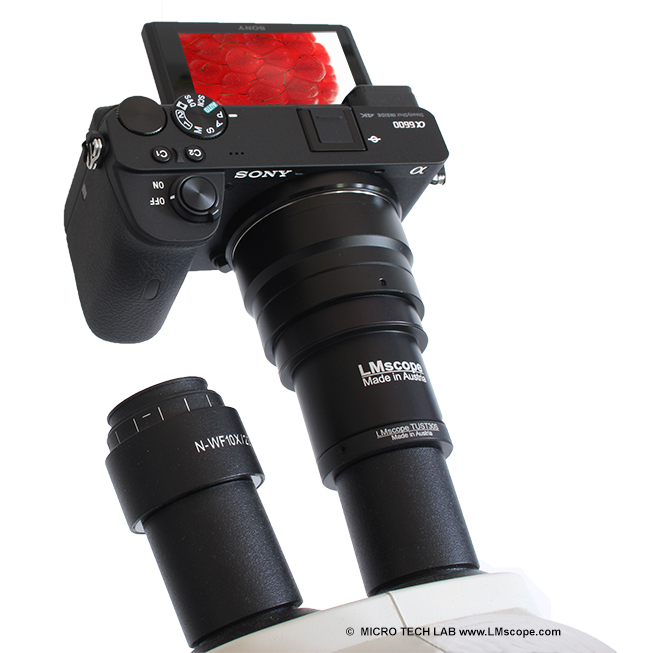
Modular design for future-proof adaptability:
Our LM adapter solutions feature a modular design. If you change or upgrade your microscope or camera equipment at some point, the adapter can be modified with minimal effort, allowing continued use regardless of the specific microscope or camera brand. Additionally, the adapter accommodates a range of optical filters, such as polarising filters, colour filters, UV filters and IR filters.
Conclusion: The NexiusZoom EVO is a solid basic-grade stereo microscope that is on a comparable level to entry-level stereo microscopes from major manufacturers such as Zeiss (Stemi 305), Nikon (SMZ745T) or Olympus (SZ61). Microscopes from the Kern OZM series also feature similar characteristics. Combined with our LM microscope adapters, the NexiusZoom EVO becomes a powerful digital documentation setup, capable of delivering excellent image definition and colour fidelity.
26.03.2026Photography:
Fitting the microscope to digital single-lens reflex (DSLR), mirrorless interchangeable-lens cameras (MILC ), digital single-lens mirrorless (DSLM) or C-mount cameras is easy with our LM digital SLR adapters, which feature a plan achromatic optical system. Our products make it possible to capture top-quality microscope images. To help you select the adapter that is right for your camera, we have set up an online configurator on our website. You can also email us – ideally with attached photographs of your microscope.
Modern DSLR and single-lens mirrorless (DSLM) offer the latest technology and are generally very well suited for microscopy applications. Most of them can be controlled remotely via PC/Mac. Because of their high sales volumes, they offer an excellent price/performance ratio compared to special-purpose microscope cameras.
Features of top DSLR and single-lens mirrorless cameras (DSLM):
- Large, powerful full-frame sensors (36 x 24 mm)
- Sensor resolution of 61 megapixels or 240 megapixels with Pixel Shift technology
- High light sensitivity (ISO 400,000+)
- Extensive dynamic range (up to 15 aperture stops/f-stops)
- Short exposure times (1/8000 second) up to 1/32,000 seconds using the digital shutter
- 4K Ultra HD or 8K Ultra HD video function
- Live video capture on external monitors in ultra HD quality
In most cases, these cameras are significantly more powerful than microscope cameras with smaller sensors (1/2" or 2/3"). On our website you will find our current camera recommendations and a camera ranking which is specifically tailored to microscopy applications.