


 772
772TEST: Sony Alpha 7R VI – how does the new star in the full-frame segment perform on the microscope?
Sony – widely regarded as a technology leader in image sensor development – introduced a brand-new member of the Alpha family in June 2026: the Sony Alpha 7R VI. In the full-frame segment, this model sets new standards in dynamic range and sensor resolution. With a body price of around € 5,000 (July 2026), it is designed for professionals in research, laboratory and advanced photomicrography environments, as well as ambitious private users.
The Alpha 7R VI’s newly developed sensor achieves extraordinary dynamic range for a full-frame camera, reaching a level of performance previously found only in professional mirrorless medium-format models, such as the FUJIFILM GFX100 II (priced at approximately € 7,500 as of 2026). In microscopy, dynamic range is one of the defining factors of image quality, as it governs a camera’s ability to capture even the faintest variations in colour and brightness, delivering significant benefits across all major microscopy methods, including:
- brightfield
- darkfield
- phase contrast
- fluorescence
- polarisation
- differential interference contrast (DIC, also known as Nomarski contrast).
With its three top camera models, the Alpha 7R VI, Alpha 9 III (the first full-frame camera with a global shutter system) and Alpha 1 II, Sony continues to extend its lead over competitors such as Canon, Nikon, Olympus and Fujifilm.
Combined with our powerful LM microscope adapters featuring integrated widefield optics, the Alpha 7R VI can be attached to virtually any microscope – either via the phototube or the eyepiece tube. This makes it an excellent, high-resolution alternative to conventional C-mount cameras.
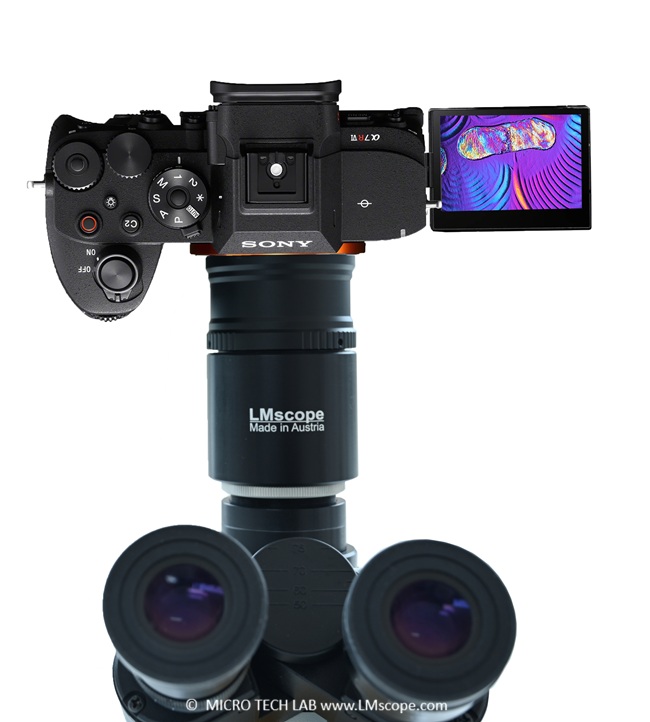
The Alpha 7R VI is the sixth generation of Sony’s celebrated high-resolution full-frame camera line. Equipped with a newly developed, fully stacked 66.8 megapixel Exmor RS CMOS sensor, coupled with the powerful BIONZ XR2 processor, the 7R VI combines the exceptional detail resolution of Sony’s “R” series with fast signal processing.
The camera’s high sensor resolution is particularly advantageous at lower microscope magnifications (below 100x), for example when working with stereomicroscopes, macroscopes and specialised photomicroscopes. It enables overview images with dedicated zoom lenses and large fields of view (FOV) to retain exceptional detail, making even minute specimen structures clearly visible at low magnifications. Even at higher magnifications (100x and above), the high sensor resolution remains an asset, as the image resolution can be adjusted directly in the camera menu whenever needed.
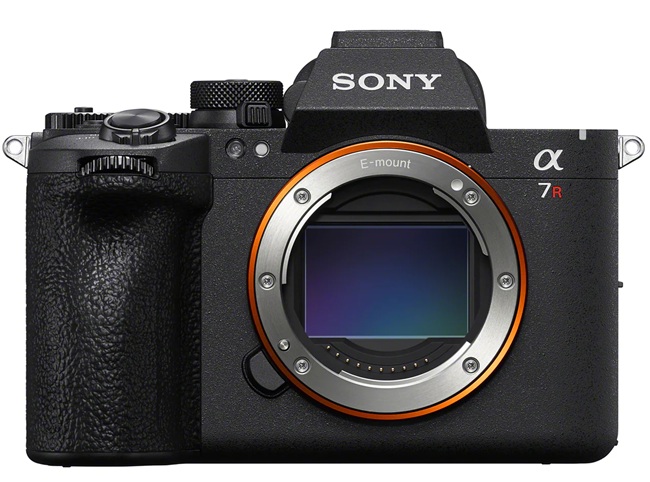
Key camera features for microscope applications:
- Sensor: 66.8 MP back-illuminated, fully stacked full-frame Exmor RS CMOS sensor without optical low-pass filter
- Processor: new BIONZ XR2 image processor with integrated AI processing unit
- Maximum dynamic range powered by DGO (dual gain output) technology
- ISO range: ISO 100–32,000 (expandable to ISO 50–102,400)
- Shutter: mechanical and vibration-free electronic shutter (anti-distortion shutter)
- Continuous shooting at up to 30 fps at maximum resolution with a buffer limit of 215 frames
- 4K and 8K video recording capabilities:
- 8K video at 30 fps
- 4K video without crop at 60 fps
- Full HD with up to 120 fps (for slow motion recording)
- Display: flexible (4-axis multi-angle) TFT LCD touchscreen (3.2"/8 cm)
- Interfaces:
- dual USB-C ports (USB 3.2) for data transfer, continuous power and charging
- Wi-Fi 6 (6 GHz band)
- HDMI: Full-size HDMI port for connecting to an external monitor
- Dual slots for CFexpress Type A SD cards
- Live streaming/webcam function: 4K video (30 fps) via USB, LAN or Wi-Fi
Maximum dynamic range with dual gain output (DGO)
To boost dynamic range over previous models, Sony has incorporated a new technology originally developed for professional video applications. DGO (dual gain output) reads, digitises and processes each pixel on the sensor simultaneously at two different amplification levels: once in low gain mode (for highlights) and once in high gain mode (for shadows). This creates two signals, which are then blended to produce an image that has both high dynamic range and low levels of noise.
Essentially, this is very similar to the HDR (high dynamic range) feature, where the camera captures multiple images at different exposures and automatically combines them into a single image with extended dynamic range.
Benefits of DGO for microscopy: Unlike HDR imaging, which relies on multi-exposure merging, DGO works by capturing both bright and dark areas of the specimen simultaneously in a single exposure, resulting in a significant boost in image quality. This makes DGO an ideal technology for capturing live or moving specimens, such as microorganisms, and for microscopy applications where mechanical shutter vibrations during continuous shooting would otherwise cause motion blur.
The Alpha 7R VI also excels as a cinema camera, offering both 8K and 4K Ultra HD video recording capabilities. For live presentations, the camera’s live feed can be output to an external monitor or projector using an HDMI cable.
Vibration-free shooting (electronic shutter)
When taking photographs through the microscope, mechanical vibrations can lead to image blur, as any movement generated by the camera shutter may be transmitted to the microscope stand, particularly at high magnifications.
The Alpha 7R VI addresses this challenge with an electronic silent shutter that operates without moving parts for silent, vibration-free shooting. The stacked sensor architecture also enables exceptionally fast redout speeds, thereby minimising rolling shutter effects (a type of image distortion that causes fast-moving live specimens, such as microorganisms, to appear warped or bent).
Display and workplace ergonomics
The 4-axis multi-angle LCD display combines the advantages of both tilting and side-opening vari-angle designs, improving ergonomics and efficiency in microscope workflows. If the camera is attached to the phototube of the microscope, the monitor can be tilted downward to provide a more comfortable viewing angle.
Illuminated rear buttons make camera operation easier in darkened laboratory environments and fluorescence microscopy workspaces.
Workflow: Tethered shooting and Live View
In professional laboratory environments, Live View camera operation is typically performed from a computer using tethered shooting.
The Sony Alpha 7R VI is equipped with the necessary interfaces to support this setup.
- USB-C ports: Dual USB-C ports support power delivery (PD) for continuous operation and simultaneous data transfer to a PC or Mac.
- Wi-Fi 6 (6 GHz): Using 2x2 MIMO technology, the camera’s built-in Wi-Fi 6 enables wireless transfer of RAW images to a tablet or computer.
- HDMI (Type A): Capable of outputting the uncompressed Live View feed to an external 4K or 8K monitor. Integrated focus peaking and focus magnification enables precise focus adjustment directly on the monitor.
Conclusion
Combined with our high-quality LM microscope adapters, the Sony Alpha 7R VI is an exceptionally powerful imaging solution for professional photomicrography. With 66.8 MP resolution, ultra-fast image processing powered by stacked sensor technology, superior light sensitivity, outstanding dynamic range and a vibration-free electronic shutter, this camera takes performance to a new level in the full-frame camera segment. These capabilities make the Alpha 7R VI an excellent choice for scientific documentation, laboratory analysis and advanced microscopy applications.
20.07.2026