


 735
735Euromex Oxion Inverso: Achieve outstanding microscope imaging quality with today’s advanced digital cameras
Inverted laboratory microscopes are at the core of modern cell biology and materials testing. Because their optical system is located below the stage, documenting cell cultures in Petri dishes or analysing bulky materials samples places unique demands on attaching camera systems to the optical setup. Our LM microscope adapters with integrated precision optics provide the ideal interface for this purpose, making the full resolving power of your inverted microscope available for digital imaging applications.
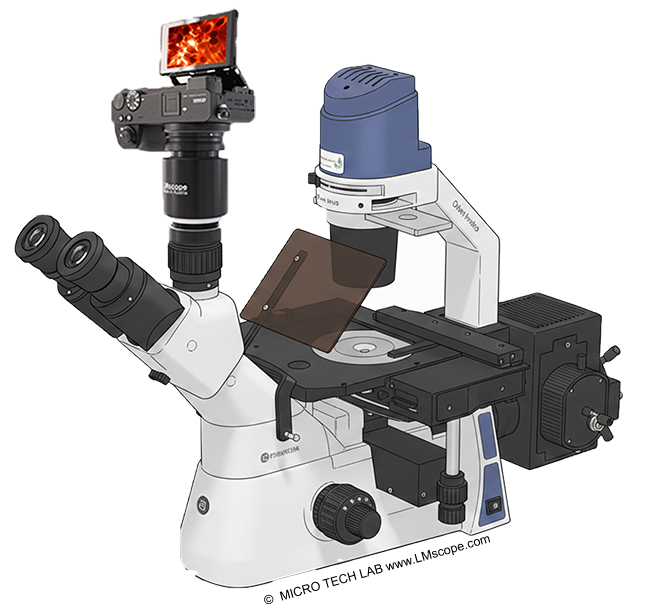
The Oxion Inverso, the inverted version of the Oxion series of microscopes made by the Dutch manufacturer Euromex, is an infinity-corrected routine inverted microscope available in two configurations:
- Oxion Inverso – optimised for life science applications and traditional live-cell observation of specimens in larger vessels. A wide range of accessories is available for this version, including an ICSI (Intracytoplasmic Sperm Injection) equipment set and a heated stage.
- Oxion Inverso MS – developed for materials science applications. Designed without condenser arm, this version provides ample space for particularly large or heavy materials samples.
To fully unlock the capabilities of this microscope, selecting the right camera interface is essential. Our LM microscope adapters with integrated precision optics allow you to take advantage of today’s most powerful digital cameras. Depending on your specific application and requirements, you can use the camera system that best meets your imaging needs:
- Modern mirrorless system cameras (DSLMs), hybrid cameras and digital single-lens reflex cameras (DSLRs) equipped with large image sensors are exceptionally powerful and a great choice for microscopy applications. Key advantages of these cameras:
- The large sensor format delivers outstanding dynamic range and excellent light sensitivity.
- As a rule, these cameras can be conveniently controlled from a computer, tablet or smartphone in Live View. Even without a computer, the live image can typically be displayed in high quality at 4K or 8K resolution on an external monitor via HDMI cable, which makes these cameras an excellent choice for live presentations.
- In addition to still photography, modern digital cameras also support high-resolution video recording (Ultra HD, 4K and 8K).
- As they are produced in large quantities, they are available at highly competitive prices. However, camera models that are a few years older and therefore more affordable also deliver excellent image quality in microscopy applications.
- For more information on making a camera selection, please see our camera info page.
- For specialised imaging applications, special-purpose microscope cameras, C-mount microscope cameras, industrial C-mount cameras, compact cameras, Ultra HD camcorders, medium format system cameras and high-speed cameras may also be suitable options. Depending on the camera system, we offer camera-specific microscope adapters with integrated precision optics.
The result is a highly flexible imaging solution that allows you to significantly improve image quality and workflow efficiency while keeping costs down.
Key microscope features:
- Inverted laboratory microscope with long working distance
- Infinity-corrected optical system (IOS)
- For life science (live-cell) and materials science applications
- Contrasting techniques: brightfield, polarisation, phase contrast and epi-fluorescence
- Plan achromatic and plan semi apochromatic objectives (5x–100x)
- Integrated phototube
- Revolving quintuple nosepiece
- Modern LED illumination
The Euromex Oxion Inverso has been an established system for many years, with its market launch dating back to 2011/2012. Depending on the selected configuration, it is currently (2026) available at a starting price of € 2,800, while fully equipped versions with accessories can exceed € 14,000.
The microscope features an infinity-corrected optical system. By default, it comes with plan achromatic IOS objectives (5x–100x), while versions with plan semi apochromatic objectives are available as well. The objectives are installed on a quintuple ball-bearing nosepiece with RMS thread.
The microscope offers brightfield and – with the appropriate accessory parts added – polarisation and phase contrast imaging modes. Epi-fluorescence is supported as well, using a 100 W HBO lamp, a variety of filter sets and specialised Fluarex semi apochromatic objectives. LED-based illumination for fluorescence is also available. The transmitted-light stage is supplied with efficient 5W NeoLED illumination featuring adjustable colour temperature.
The height-adjustable eyepiece tube has a 30 mm insert diameter and is typically equipped with HWF 10x/22 eyepieces. 15x/16 eyepieces are available as an alternative. The viewing angle is 45 degrees, and the interpupillary distance can be adjusted from 54 to 75 mm.
The preferred way to attach a camera to the microscope is with our LM direct adapter, which is attached directly to the basic phototube (38 mm internal diameter). A lever is used to split the beam of light with a 100:0 / 0:100 light split (bino : photo). To maximise the amount of light reaching the camera sensor, we recommend using the 0:100 split while controlling the camera remotely in Live View from a PC/Mac.
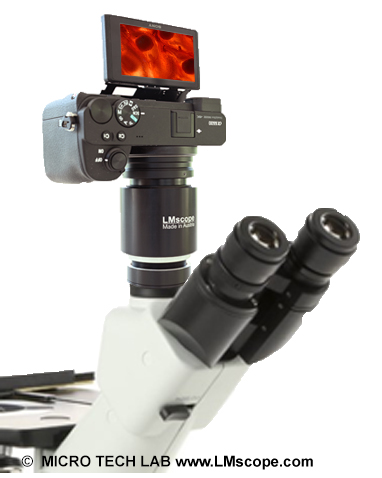
Alternatively, we offer adapter solutions with particularly large lens diameters for the manufacturer’s own 1x C-mount adapter (CS/C mount, part no. OX.9810).
For microscopes that don’t have a phototube, our adapters can also be used to connect the camera to the eyepiece tube. To attach the camera, one eyepiece is removed and the camera-adapter combination is put into its place. The image quality obtained with this method is very good, but you have just one eyepiece left for visual observation.
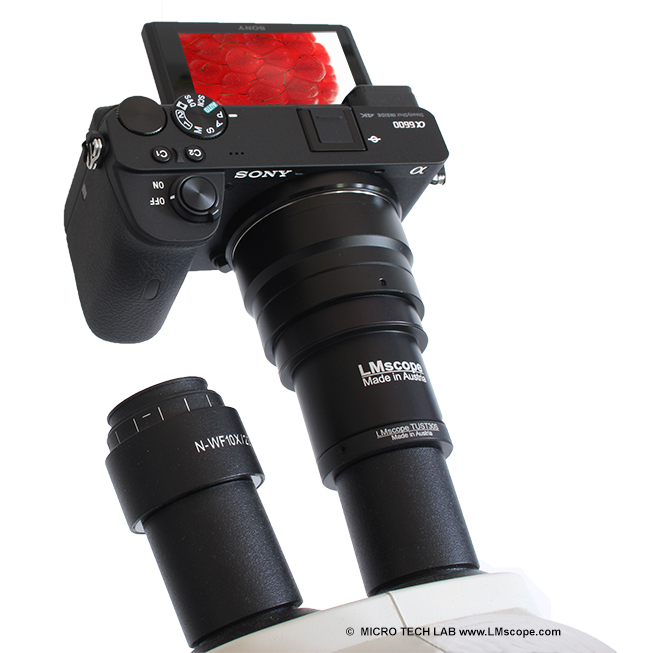
Particularly in inverted microscope systems, which are frequently used for phase contrast, polarisation or fluorescence techniques, light capture is a critical factor. For these demanding low-light applications, we recommend the LM wide-field adapter:
- Maximum light gathering power: A large-diameter lens design combined with high-quality wide-field optics ensures that light from the objective is transmitted to the camera sensor with maximum efficiency.
- Perfect parfocality: The integrated focusing unit allows for an adjustment of the image viewed through the eyepieces, bringing it into exact alignment with the digital image displayed on the monitor.
- Modular build: LM adapters are designed to integrate seamlessly with phototubes from a wide range of manufacturers – regardless of whether they are common trinocular tubes or camera ports located on the side of the microscope (sideports).
- Extended contrast control: An integrated filter holder allows the placement of cut-off or correction filters directly in the optical path. Optional quick-change modules are available to speed up workflows when switching between different illumination methods.
Your benefit: By combining a high-quality inverted microscope with a modern, cost-efficient digital camera, you achieve a level of image quality that often exceeds that of conventional all-in-one solutions. At the same time, you improve the efficiency of your documentation while maintaining full flexibility to adapt to future camera generations.
04.05.2026Photography:
Fitting the microscope to digital single-lens reflex (DSLR), mirrorless interchangeable-lens cameras (MILC ), digital single-lens mirrorless (DSLM) or C-mount cameras is easy with our LM digital SLR adapters, which feature a plan achromatic optical system. Our products make it possible to capture top-quality microscope images. To help you select the adapter that is right for your camera, we have set up an online configurator on our website. You can also email us – ideally with attached photographs of your microscope.
Modern DSLR and single-lens mirrorless (DSLM) offer the latest technology and are generally very well suited for microscopy applications. Most of them can be controlled remotely via PC/Mac. Because of their high sales volumes, they offer an excellent price/performance ratio compared to special-purpose microscope cameras.
Features of top DSLR and single-lens mirrorless cameras (DSLM):
- Large, powerful full-frame sensors (36 x 24 mm)
- Sensor resolution of 61 megapixels or 240 megapixels with Pixel Shift technology
- High light sensitivity (ISO 400,000+)
- Extensive dynamic range (up to 15 aperture stops/f-stops)
- Short exposure times (1/8000 second) up to 1/32,000 seconds using the digital shutter
- 4K Ultra HD or 8K Ultra HD video function
- Live video capture on external monitors in ultra HD quality
In most cases, these cameras are significantly more powerful than microscope cameras with smaller sensors (1/2" or 2/3"). On our website you will find our current camera recommendations and a camera ranking which is specifically tailored to microscopy applications.