Top Microscopy articles 
Sensor sensitivity (ISO) in digital cameras
Digital SLR / System Camera with the Leica Wild M420 macroscope
Microscope wide-field adapter for eyepiece tubes with 30 mm inner diameter
Professional photo documentation using a digital SLR camera made easy with the Zeiss OPMI
Canon EOS 600D impresses us at the microscope
Professional photo documentation using a digital SLR camera with Bresser microscopes equipped with a phototube
Photography with a display mirror on the micro- or macroscope
Sony Alpha 55 scores points on the microscope
Canon EOS 5D Mark II
LM universal DSLR adapter
Sony NEX-5 and Sony NEX-3 in microscopy
Professional photo documentation using a digital SLR camera with Möller-Wedel microscopes
Upgrading made easy!
Recycling old LM microscope adapters for digital compact cameras and camcorders
LM digital adapter connection now also available for compact cameras!
Which digital camera functions best on a microscope?
Compact cameras and camcorders on the microscope
DSLR cameras are simply better!
Improved picture quality through mirror lock-up in SLR cameras
Top Macro photography articles 
All-purpose filter adapter for macroscopy
DMLDSLR40Set:Connection ring for two LM Macro 80 lenses (close-up lenses) 
Create your own LED Microscope / Macroscope Lighting
Macro photography with the Sony Alpha 55
LM DSLR macroscope: Professional photographic documentation for a bargain price
Macro photography with the Olympus pancake 17 mm lens and the LM close-up lens 80mm
Digital macro photography with “classic analogue lenses” at bargain prices
Are normal stereo microscopes suitable for high-quality photographic documentation?
Turn your digital reflex camera into a microscope
LM Macrooptics Workshop
Compatibility list for LM close-up lenses
more articles


Folge Micro_Tech_Lab auf Twitter        ID188
USB (universal serial bus) video cameras in microscopy – quite simply far too slow!

USB cameras are often offered as eyepiece cameras (video eyepieces) or with a C-mount connection. The components and quality vary greatly between different manufacturers, but all of them have one thing in common: they have a bandwidth problem! Digital video cameras are able to take pictures in high resolution, but unfortunately they cannot transport the data stream to the computer quickly enough. This results in data blockages and the number of images transmitted per second falls off sharply. The current USB connections (USB 1.1 and 2.0) pose a bottleneck for the data stream. The currently fastest USB 2.0 connection would need to be at least 10 times faster in order to transfer a video sequence fluently in real time to the computer. In the entertainment industry, for a 2 megapixel resolution or full HD with 1920 x 1080 pixels with 30 pictures per second, a data transfer rate of 3960 Mbit/second is planned.
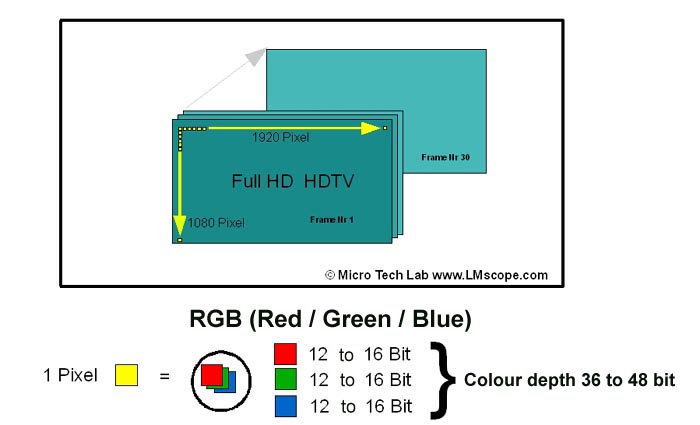
The required bandwidth is calculated as follows: 1920 pixels x 1080 pixels x 36 bit (colour depth per pixel) x 30 images per second = 2240 Mbit/second

USB 2.0 cameras with resolutions of up to 10 megapixels only provide a data transfer rate of 480 Mbit/second.

Interface Data transfer rate
USB1 12 Mbit/second
USB2 480 Mbit/second
USB3 (not yet on the market) 5000 Mbit/second
HDMI 1.2 3960 Mbit/second
DVI 3700 Mbit/second

The greatly reduced image reproduction rate under 10 images per second poses a problem when focussing the microscopic images.
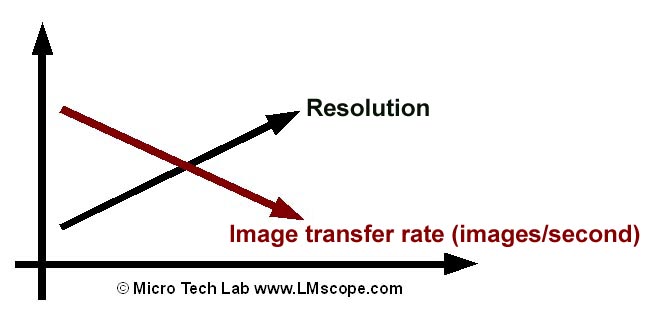
A strong time lag makes the choice of the optimum focal plane more difficult. If a lower resolution is selected, the focal plane is more difficult to find.

Conclusion: For professional use in microscopy, we can only recommend USB cameras with reservations. However, with a little patience and intuition, good results can be achieved. The new digital HD SLR cameras, such as Canon’s EOS 5D II with “Live View” and HDMI output, offer an alternative to expensive HD video cameras. In video mode, these cameras deliver a real time preview in HD (high definition) quality via the HDMI output. The large format sensor chip of digital SLR cameras has an excellent signal to noise ratio and a photo resolution of over 20 megapixels.

Related Links
Are HD single lens reflex cameras the better HD camcorders?
Analogue video output (AV) versus the digital HD output (HDMI) of digital cameras (digicams)
LMscope has developed an innovative LM filter adapter for using compact cameras in microscopy. Using the filter adapter makes it possible to connect almost every existing and future compact camera
Grammarus roeselii, video. Used instruments: LM Digital Adapter, Zeiss Standard microscope, Sony DV Camcorder DCR PC 120E, Notebook Gericom Webboy XL 1000
Archiving high definition (HD) videos in microscopy, using the DivX®6.4 video compression codec with Microsoft™ Windows Vista
DivX®5: Setting up and editing a database of video sequences by using the video compression system
Using the Canon XL H1 / XL H1A / XL H1S / XL2 with a microscope
VirtualDub 1.7 open source tool in microscopy to view and record
In microscopy, digital SLR cameras are the better video cameras!
HD Camcorder for use with a microscope for the bargain price of EUR 79.00
HD video macroscope with digital HD camcorder for a bargain price of EUR 79.00!
Full HD video macroscope for a bargain price with Aiptek AHD H5 Extreme digital full HD camcorder


High-end intermediate optics for connecting microscopes to:
  • digital compact cameras
  • digital SLR cameras
  • digital camcorders
  • video cameras
  • professional studio HDV camcorders
[Further information amd prices]
Which digital camera functions best on a microscope?
Convert your digital SLR camera into a professional microscope
Special mounting media  for microscopy

Tips and tricks to connect your digital camera and to process digital images


© 1999-2011 MICRO TECH LAB. All rights reserved
 
--
Products Contact How to order Site Map Press Center Price List
Magazine Newsletter Reference Clients Imprint Demo Pictures Camera Ranking