


 187
187Compact cameras and camcorders on the microscope : Digital single lens reflex cameras and mirrorless system cameras are simply better!
Compact cameras and camcorders are among the most popular types of digital cameras due to their convenient size, ease of operation and the many applications they offer. As they are primarily designed for capturing objects, landscapes and people, these cameras are not the best choice for photomicrography and macrophotography.
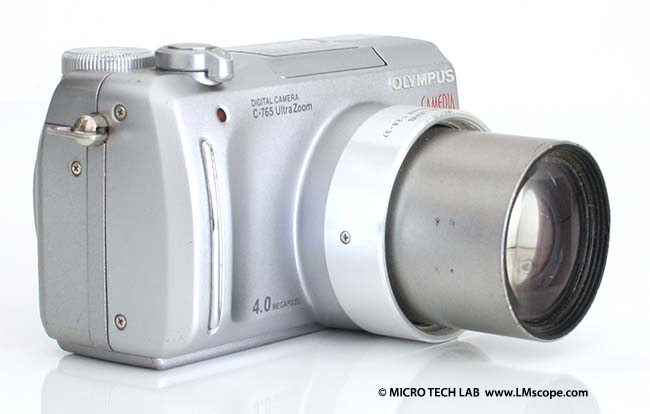
Compact cameras (see image on the left) have one thing in common: the lens unit is fixed within the camera body and cannot be removed. For applications involving microscopy and macroscopy, however, the camera lens is not only unneeded, but even somewhat of a hindrance.
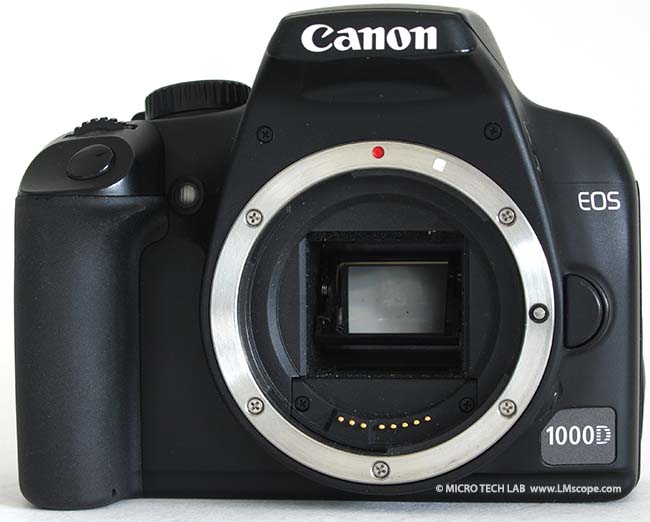
In the case of digital single lens reflex cameras (DSLRs, see image on the right), the lens is connected to the camera body by a bayonet fitting. That design is beneficial for microscopy applications because the microscope’s adapter, which performs the camera’s mechanical and optical adjustments, can project the image directly to the camera’s sensor.
At present, two different types of lens designs are used in compact cameras:
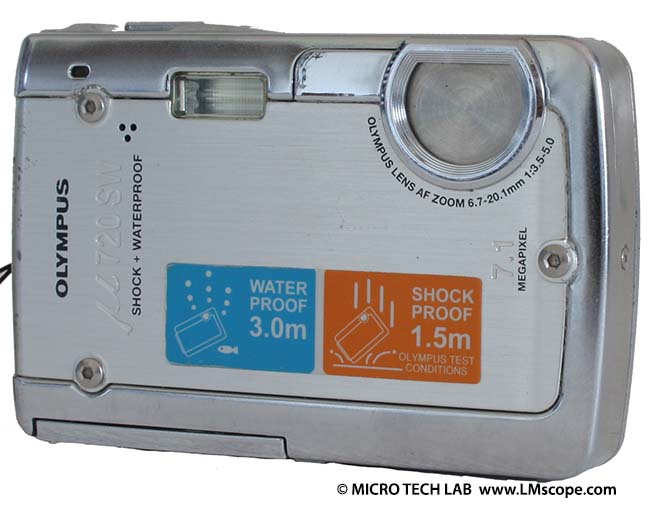
- Lenses that are housed entirely within the camera body and do not need to be extended for use. This approach is used mainly in ultra-compact cameras, which are extremely small in size, and also in camcorders.
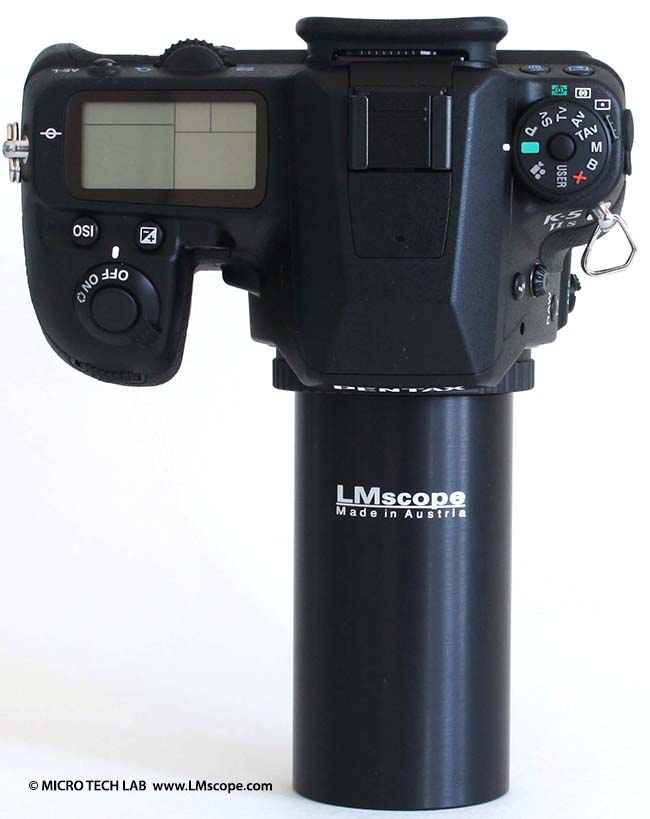
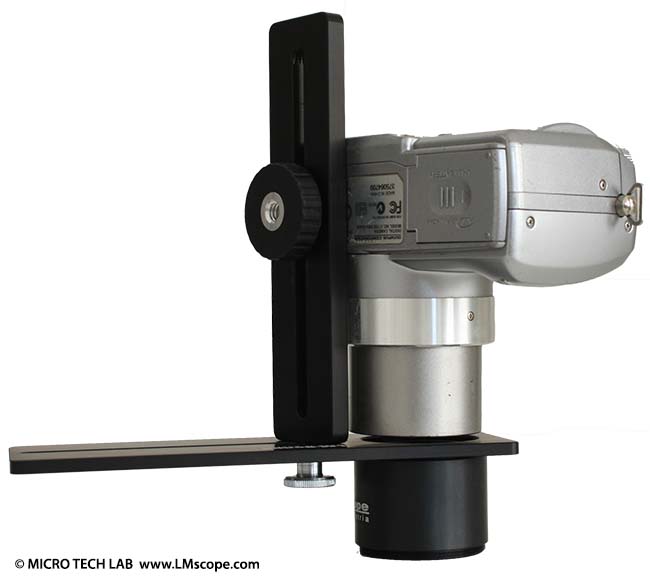
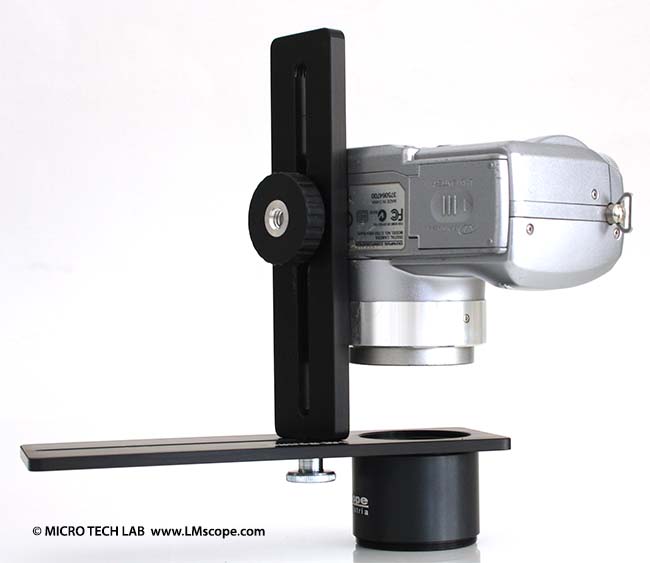
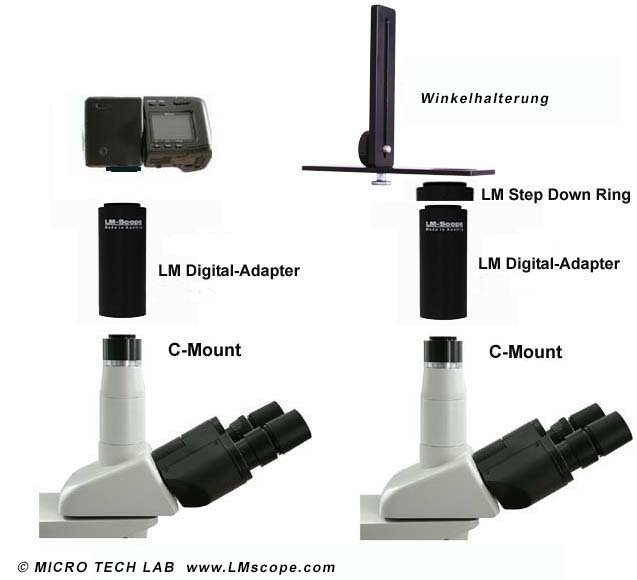
As the zoom factor in these cameras is not particularly large (the zoom system contains only a few lens elements), they are the most suitable type of compact cameras for microscopy applications. Some of these cameras and camcorders have a filter thread at the front of the camera body which makes it quite easy to attach the camera/camcorder firmly to the microscope (see image on the left). If there is no filter thread, the camera/camcorder can be mounted to the microscope using an angle bracket as a makeshift connector (see image on the right).
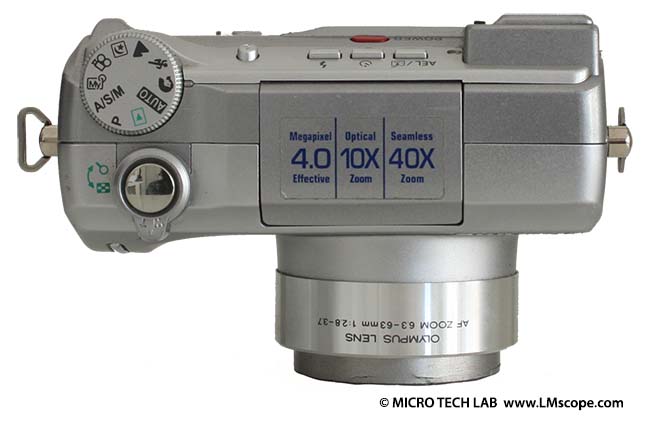
- Compact cameras equipped with extendable lenses that offer greater zoom factors. These cameras have wide-aperture lenses with a large front element. At the long end of the zoom range, the lens protrudes several centimetres from the front of the camera. Despite their high quality, these camera models are unfortunately not well suited for microscopy applications. The mechanical attachment of the camera to the microscope is extremely difficult and can never be done perfectly. By extension, if the camera is not connected firmly to the adapter, there are risks of motion blurring, inexact optical axis alignment and stray light entering the photo tube.
In fact, modern zoom lenses represent the biggest problem when using compact cameras or camcorders on a microscope:
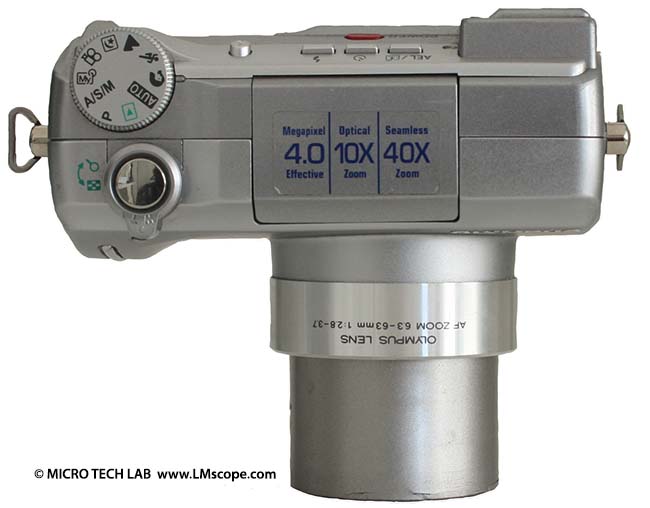
- Due to increasingly complex lenses, the zoom range of compact cameras is constantly being expanded. Every lens unit of this type contains a large number of spherical and aspherical lens elements. As a result, when such lenses are used with a microscope, they cause a significant deterioration in image quality, such as poor focus at the edge of the image, distortions, chromatic aberrations, washed out colours and vignetting (peripheral darkening). Ideally, the lens unit should be removed completely, but unfortunately, in the case of most compact cameras this is not possible without destroying the camera body.
- Furthermore, incorrect autofocus settings or the application of erroneous focus to an object other than the target often causes blurred images. It is not always easy to “outsmart” the automatic features of such lenses.
- With a fixed lens, on the other hand, the field of view (FoV) cannot be adjusted optimally. As with all compact cameras, microscopic images must be taken at high zoom settings, i.e. at tele setting, and in extreme cases even in digital zoom mode. However, the higher the zoom level, the smaller the image section that will be produced. In many cases, the surface area of the captured image ranges from just 25%–40% of the image visible through the eyepiece.
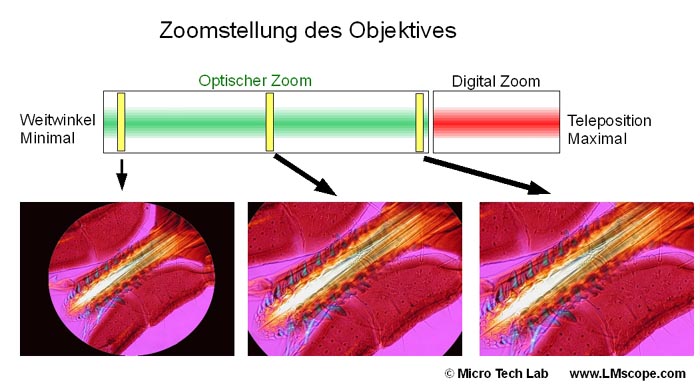
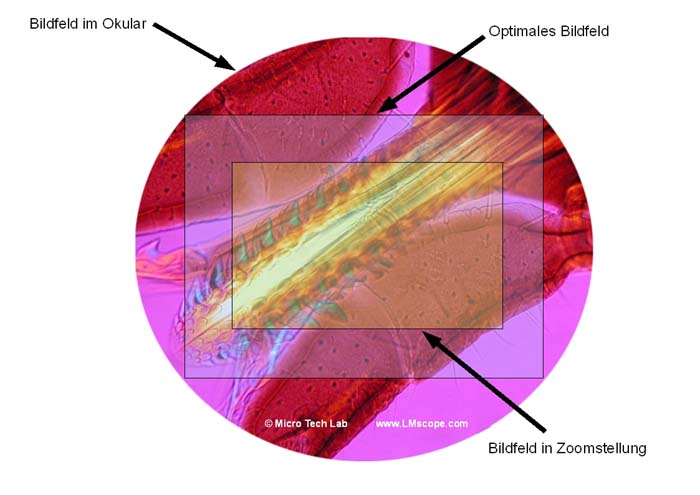
Slight vignetting may sometimes occur along the edge of the image, and those undesirable black edges can be removed only by using the digital zoom or image editing applications.
The technology used in compact cameras cannot compete with that of DSLRs. Compact cameras have much smaller image sensors that provide weaker signal-to-noise ratios, lower depths of colour, resolution and dynamics, and fewer options for exposure time settings. These shortcomings result in a significantly inferior image quality.
For photomicrography and macrophotography applications, we recommend controlling the camera remotely via PC or Mac. This not only prevents the motion blurs caused by pressing the camera’s shutter release button, but it also permits the camera to be navigated on the screen and enables Live View output to a larger monitor. The Live View magnification function included in most software packages offers many additional advantages. For instance, images can be saved directly to the PC’s hard drive, a function not typically possible with compact cameras. Also, when a compact camera is used for photomicrography or macrophotography applications, the use of its small, integrated screen for camera operations is quite inconvenient.
Thus, the primary function behind the use of microscope adapters for compact cameras is to mitigate the negative characteristics of the camera’s lens unit and project the microscopic image onto the sensor. This works quite well with some cameras but much less so with others.
Notably, the performance gap between compact cameras and DSLRs has continued to increase in recent years.
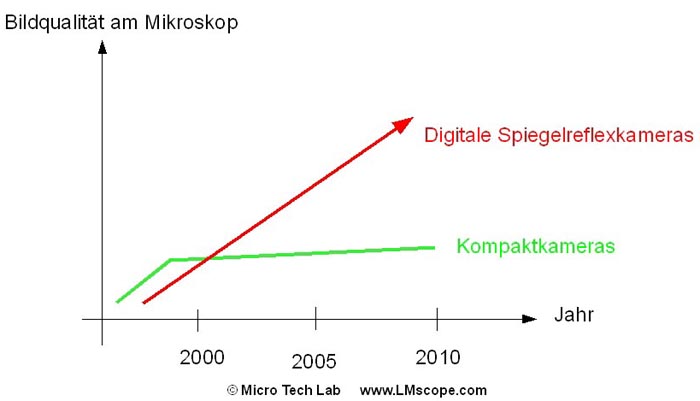
Although camera prices are continuing to fall (especially among compact cameras), new high performance technologies that improve image quality are typically available in only the top range of DSLR models. However, new entry-level models that start at EUR 300.00, or used DSLRs manufactured after 2007 (such as the Canon EOS 1000D or EOS 1200D) are also very well suited for microscopy. A list of digital cameras ranked according to their suitability for microscopy applications can be found on our website at: Which digital camera works best with microscopes?
Conclusion:
In the professional field, we would advise against the use of compact cameras for photomicrography. Those with a serious interest in microscope photography should not cut corners when it comes to the camera they choose. DSLR cameras and system cameras are far superior to compact cameras when photomicrography applications are concerned. For this reason, we recommend using modern DSLR and system cameras. We offer a wide range of products that facilitate connecting these cameras to optical instruments.
22.10.2015
New LM Digital Adapter for: Nikon Z9 / Nikon Z8 / Sony Alpha 7R V / Canon EOS R3 / Canon EOS R6 Mark II / Canon EOS R8 / Sony Alpha 7R IV / Canon EOS R5 / Canon EOS R6 / Nikon Z6 / Nikon Z6II / Nikon Z7 / Nikon Z7II / Canon EOS R / Canon EOS Ra (Astro) / Nikon Z5 / Canon EOS RP / Canon EOS R7 / Leica SL2-S / Canon EOS R10 / Nikon Z30 / Nikon Z fc / Olympus OM-1 / Olympus OM-D E-M1 Mark III / Canon EOS R100 / Fujifilm X-H2S / Pentax K-1 / Fujifilm X-S10 / Fujifilm X-E4 / Fujifilm X-Pro3 / Olympus OM-D E-M1X / Sony Alpha 6400 / Olympus OM-D E-M5 III / Fujifilm X-T4 / Fujifilm X-T3 / Canon EOS M6 Mark II / Panasonic Lumix DC-G9 / Canon EOS M200 / Canon EOS M50 Mark II / Canon EOS M50 / Olympus OM-D E-M5 II / Leica M11 / Leica M10 Monochrom / Olympus PEN-E-PL9 / Leica M10 / Olympus PEN-F / Olympus OM-D E-M5 Mark II / Fujifilm X-T1 / Panasonic Lumix DC-GH5S / Olympus OM-D E-M10 Mark II / Panasonic Lumix DMC-G81 / Fujifilm X-A5 / Panasonic Lumix DMC-GX9 / Panasonic Lumix DMC-GX80 / Olympus OM-D E-M10 Mark III / Fujifilm X-T2 / Fujifilm X-H1 / Fujifilm X-T20 / Fujifilm X-E3 / Fujifilm GFX 50S / Fujifilm X-E3 / Fujifilm X-Pro2 / Fujifilm X-T100 / Fujifilm X-A3 / Panasonic Lumix DMC-FZ38 / Panasonic DMC-FT3 / Panasonic HDC-SD800 / Panasonic HDC-SD909 / Panasonic HDC-TM900 / Panasonic HDC-HS900 / Nikon Coolpix S8100 / Nikon Coolpix S9100 / Sony DSC-HX9V / Sony DSC-HX100V / Sony DSC-WX7 / Sony DSC-WX10 / Sony DSC-H70 / Sony DSC-HX7V / Sony DSC-TX10 / Sony DSC-TX100V / Panasonic DMC-FS18 / Panasonic DMC-FS35 / Panasonic DMC-FS37 / Fujifilm FinePix F550EXR / Fujifilm FinePix F500EXR / Fujifilm FinePix HS20EXR / Canon IXUS 1000 HS / Panasonic DMC-TZ22 / Canon IXUS 310 HS / Sigma DP2s / Panasonic DMC-FS16 / Panasonic DMC-TZ18 / Olympus SP-610UZ / Fujifilm FinePix Z90 / Fujifilm FinePix T300 / Fujifilm FinePix XP30 / Fujifilm FinePix S2950 / Fujifilm FinePix S3300 / Fujifilm FinePix S4000 / Canon PowerShot S80 / Olympus C-7070 Wide Zoom / Sony HDR-CX700 / Nikon Coolpix P500 / Panasonic DMC-FX77 / Panasonic DMC-FT3 / Sony DSC-HX7V / Casio Exilim EX-H30 / Panasonic Lumix DMC-FS35 / JVC GZ-HM845 / Canon PowerShot A3300 IS / Samsung PL170 / Nikon Coolpix S6100 / Sony DSC-W570 / Sony DSC-J10 / Sony DSC-T110 / Olympus SZ-20 / Olympus SZ-30MR / Casio EX-H30 / Olympus C-5060 Wide Zoom / Panasonic Lumix DMC-FZ100 / Panasonic HDC-SD99 / Canon PowerShot G12 / Canon IXUS 300 HS / Nikon Coolpix P7000 / Leica D-Lux 20 / Fujifilm FinePix HS10 / Fujifilm FinePix X100 / Panasonic Lumix DMC-FX150 / Samsung NV100 HD / Canon PowerShot G10 / Nikon Coolpix 4500 / Canon HR10 / Nikon Coolpix S710 / Canon IXUS 980 IS / Sony Cyber-shot DSC-H55 / Canon PowerShot SX210 IS / Canon IXUS 130 / Canon IXUS 210 / Nikon Coolpix S8000 / Sony Cyber-shot DSC-W320 / Sony Cyber-shot DSC-W350 / Sony Cyber-shot DSC-W360 / Sony Cyber-shot DSC-W380 / Panasonic Lumix DMC-FS11 / Panasonic Lumix DMC-FS30 / Panasonic Lumix DMC-FS30 / Panasonic Lumix DMC-FX66 / Panasonic Lumix DMC-ZX3 / Panasonic Lumix DMC-FT2 / Fujifilm FinePix JZ500 / Olympus FE-47 / Olympus FE-4040 / Olympus FE-5035 / Olympus mju-5010 / Olympus mju-7040 / Olympus mju-9010 / Olympus mju Tough-6020 / Olympus mju Tough-8010 / Olympus SP-800UZ / Casio Exilim EX-Z550 / Casio Exilim EX-Z2000 / Casio Exilim EX-H15 / Samsung PL200 / Nikon Coolpix S1100pj / Leica V-LUX 2 / Sony Cyber-shot DSC-T99 / Pentax RS1000 / Pentax RZ10 / Panasonic DMC-FX70 / Panasonic DMC-FX700 / Panasonic DMC-FT10 / Panasonic DMC-FZ45 / Panasonic DMC-FZ100 / Fujifilm JX280 / Fujifilm S2800HD / Olympus FE-5050 / Casio EX-Z800 / Panasonic Lumix DMC-FS16 / Samsung WB700 / Canon PowerShot A2200 / Samsung PL120 / Samsung SH100 / Samsung WB710 / Samsung WB210 / Nikon Coolpix S4100 / Nikon Coolpix S1100pj / Nikon Coolpix L120 / Nikon Coolpix P300 / Sony DSC-W530 / Pentax RS1500 / Pentax S1 / Olympus VG-130 / Olympus TG-310 / Olympus TG-610 / Olympus TG-810 / Olympus VR-330 / Casio CX5 / Casio EX-HG20G / Nikon Coolpix 995 / Nikon Coolpix 990 / Sony Cyber-shot DSC-W300 / Samsung L310W / Nikon Coolpix P6000 / Nikon Coolpix P6000 / Samsung WB5500 / Panasonic HDC-SD80 / Panasonic HDC-TM80 / Panasonic HDC-HS80 / Ricoh GX 200 / Fujifilm Fuji F100fd / Panasonic Lumix DMC-FX100 / Fujifilm Fuji F60fd / Pentax A40 / Pentax S12 / Nikon Coolpix P5100 / Canon PowerShot G9 / Nikon Coolpix S700 / Canon IXUS 960 IS / Exilim EX-Z1200 / Kodak Z1275 / Kodak Z1285 / Nikon Coolpix P5100 / Voigtländer Vitoret 120 D / GE E Series E1235 / Sanyo Xacti VPC-1200 / Pentax X70 / Samsung IT100 / Samsung WB100 / Samsung WB550 / Canon IXUS 100 IS / Canon IXUS 110 IS / Canon PowerShot A1100 IS / Canon IXUS 990 IS / Canon PowerShot A2100 IS / Canon PowerShot D10 / Canon PowerShot SX200 IS / Fujifilm FinePix F200EXR / Nikon Coolpix P90 / Nikon Coolpix S620 / Nikon Coolpix S630 / Panasonic Lumix DMC-FS25 / Panasonic Lumix DMC-FT11 / Panasonic Lumix DMC-FX40 / Panasonic Lumix DMC-FX550 / Sony DSC-T90 / Sony DSC-T900 / Sony DSC-W230 / Sony DSC-W270 / Sony DSC-W290 / Casio Exilim Card EX-S12 / Casio Exilim EX-Z400 / Olympus FE-3010 / Olympus mju 5000 / Olympus mju 7000 / Olympus mju 9000 / Olympus mju Tough 8000 / Pentax Optio P70 / Samsung PL65 / Samsung ST50 / Sony DSC-W210 / Sony DSC-W220 / Casio EX-H10 / Ricoh GX200 / Olympus FE-26 / Olympus FE-46 / Olympus FE-4000 / Olympus FE-5020 / Olympus mju 7020 / Olympus mju 9000 / Olympus mju Tough 6010 / Olympus SP-590 UZ / Fujifilm FinePix J30 / Fujifilm FinePix S200EXR / Panasonic Lumix DMC-FS15 / Panasonic Lumix DMC-FP8 / Panasonic Lumix DMC-FX60 / Panasonic Lumix DMC-FT1 / Panasonic Lumix DMC-ZX1 / Sony Cyber-shot DSC-W190 / Sony Cyber-shot DSC-W275 / Canon PowerShot SX20 IS / Canon IXUS 120 IS / Canon IXUS 200 IS / Nikon Coolpix S570 / Nikon Coolpix S640 / Nikon Coolpix S70 / Nikon Coolpix S1000pj / Pentax Optio P80 / Pentax Optio W80 / Canon PowerShot A3100 IS / Canon IXUS 105 / Samsung PL100 / Samsung PL150 / Samsung WB600 / Samsung WB650 / Nikon Coolpix L22 / Nikon Coolpix L110 / Nikon Coolpix S3000 / Nikon Coolpix S4000 / Sony Cyber-shot DSC-W310 / Pentax Optio H90 / Pentax Optio I-10 / Pentax Optio W90 / Pentax Optio X90 / Panasonic Lumix DMC-FP1 / Panasonic Lumix DMC-FS10 / Panasonic Lumix DMC-TZ8 / Panasonic Lumix DMC-TZ10 / Fujifilm FinePix JX200 / Fujifilm FinePix Z70 / Fujifilm FinePix Z700EXR / Fujifilm FinePix F80EXR / Fujifilm FinePix XP10 / Fujifilm FinePix S1600 / Fujifilm FinePix S1800 / Fujifilm FinePix S2500HD / Olympus mju Tough-3000 / Olympus SP-600UZ / Voigtländer X-120 / Casio Exilim EX-Z330 / Nikon Coolpix S5100 / Sony Cyber-shot DSC-WX5 / Sony Cyber-shot DSC-TX9 / Fujifilm Z800EXR / Fujifilm F300EXR / Casio EX-H5 / Ricoh G700 / Casio Exilim EX-ZR100 / Sony HDR-CX360 / Canon PowerShot A1200 / Canon PowerShot SX130 IS / Canon PowerShot SX220 HS / Canon PowerShot SX230 HS / Canon IXUS 115HS / Canon IXUS 220HS / Nikon Coolpix S5100 / Sony DSC-W510 / Olympus VG-110 / Casio EX-TR100 / Casio EX-ZR100 / Fujifilm Fuji S100FS / Kodak EasyShare V1073 / Samsung L201 / Casio Casio Exilim EX-Z200 / Sony Cyber-shot DSC-W170 / Fujifilm Fuji J150W / Fujifilm Fuji J100 / Canon IXUS 90 IS / Canon IXUS 85 IS / Nikon Coolpix P80 / Sony Cyber-shot DSC-T77 / Pentax M60 / Pentax E60 / Nikon Coolpix S60 / Pentax W60 / Ricoh R50 / Panasonic Lumix DMC-FZ50 / Samsung NV40 / Panasonic Lumix DMC-FX37 / Panasonic Lumix DMC-FX35 / Samsung NV24 HD / Panasonic Lumix DMC-FZ28 / Fujifilm Fuji Z20fd / Panasonic Lumix DMC-FS20 / Sanyo E10 / Voigtländer Vito V 10 / Casio Exilim EX-S10 / Lumix DMC-LZ10 / Samsung NV9 / Ricoh R8 / Panasonic Lumix DMC-FS5 / Leica D-Lux 4 / Leica C-Lux 3 / Panasonic Lumix DMC-LX3 / Leica D-Lux 3 / Panasonic Lumix DMC-LX2 / Leica V-Lux 1 / Canon PowerShot A2000 IS / Canon PowerShot A1000 IS / Canon PowerShot E1 / Nikon Coolpix P5000 / Canon PowerShot A640 / Fujifilm FinePix J250 / Canon PowerShot G7 / Ricoh GR Digital II / Casio Exilim EX-Z100 / Ricoh Caplio GX100 / Samsung L210 / Sony Cyber-shot DSC-T300 / Casio Exilim EX-Z300 / Panasonic Lumix DMC-FX500 / Sony Cyber-shot DSC-T500 / Nikon Coolpix S550 / Olympus SP-565 ZU / Olympus SP-570 ZU / Nikon Coolpix S600 / Ricoh Caplio G 600 / Nikon Coolpix S610 / Nikon Coolpix S610c / Sony Cyber-shot DSC-T700 / Canon IXUS 970 IS / Canon Fuji S1000fd / Olympus mju1010 / Kodak EasyShare C1013 / Kodak EasyShare Z1015IS / Olympus mju1020 / Olympus mju1030 / Olympus mju1030 SW / Kodak EasyShare M1033 / Olympus mju1040 / Olympus mju1050 SW / Olympus mju1060 / Voigtländer Virtus XM1060 / Samsung S1060 / Samsung S1070 / Kodak EasyShare M1093IS / Fujifilm Fuji S2000HD / Fujifilm Fuji S8100fd / Canon PowerShot SX 10 IS / Canon IXUS 870 IS / Sanyo Xacti VPC-S1070 / Sanyo Xacti VPC-E1075 / GE E Series E1035 / GE E Series E1050TW / Canon PowerShot SX1 IS / Pentax Optio E70L / Canon IXUS 95 IS / Fujifilm FinePix A100 / Fujifilm FinePix A150 / Fujifilm FinePix J20 / Fujifilm FinePix J210 / Fujifilm FinePix J25 / Fujifilm FinePix J250 / Fujifilm FinePix S1500 / Fujifilm FinePix Z30 / Fujifilm FinePix Z33WP / Jenoptik JD10.0z3 SS / Jenoptik JD10.0z3 TS / Nikon Coolpix L100 / Nikon Coolpix L20 / Nikon Coolpix S220 / Nikon Coolpix S225 / Nikon Coolpix S230 / Panasonic Lumix DMC-TZ6 / Panasonic Lumix DMC-TZ7 / Sony DSC-H20 / Sony DSC-S930 / Canon PowerShot A480 / Casio Exilim EX-Z1 / Casio Exilim EX-Z270 / Olympus FE-45 / Olympus FE-5000 / Olympus mju 550WP / Olympus mju Tough 6000 / Pentax Optio E70 / Samsung ES55 / Samsung PL50 / Samsung PL60 / Samsung WB500 / Sony DSC-S950 / Voigtländer Vitolux S 100 / Voigtländer Vito V 10 / Voigtländer Virtus XM 1060 / Ricoh R10 / Ricoh GR digital III / Fujifilm FinePix Z37 / Fujifilm FinePix Z300 / Fujifilm FinePix F70EXR / Fujifilm FinePix REAL 3D W1 / Panasonic Lumix DMC-FS7 / Panasonic Lumix DMC-LX3 / Sony Cyber-shot DSC-W180 / Sony Cyber-shot DSC-WX1 / Sony Cyber-shot DSC-TX1 / Canon PowerShot SX 120 IS / Canon PowerShot S90 / Canon PowerShot G11 / Pentax Optio E80 / Pentax Optio WS80 / Canon PowerShot A490 / Canon PowerShot A495 / Canon PowerShot A3000 IS / Samsung WB2000 / Samsung EX1 / Nikon Coolpix P100 / Sony Cyber-shot DSC-TX5 / Sony Cyber-shot DSC-TX7 / Sony Cyber-shot DSC-HX5V / Pentax Optio E90 / Fujifilm FinePix HS10 / Casio Exilim EX-FH100 / Ricoh CX3 / Canon PowerShot S95 / Canon IXUS 300 HS / Canon IXUS 1000 HS / Nikon Coolpix P7000 / Leica D-LUX 5 / Panasonic DMC-LX5 / Fujifilm REAL 3D W3 / Casio EX-FH25 / Ricoh CX4 / Panasonic Lumix DMC-LX5 / Olympus XZ-1 / Canon PowerShot A800 / Canon PowerShot S95 / Samsung EX1 / Nikon Coolpix L23 / Olympus X-Z1 / Ricoh CX5 / Casio Exilim EX-Z85 / Nikon Coolpix S52 / Nikon Coolpix S52c / Sony Cyber-shot DSC-H50 / Sanyo XACTI CG9 / Panasonic Lumix DMC-TZ5 / Canon PowerShot SX110 IS / Exilim EX-Z250 / Casio Exilim EX-Z21 / Sony DSC-HX1 / Samsung PL10 / Ricoh CX1 / Casio Exilim EX-FC100 / Casio Exilim EX-FS10 / Nikon Coolpix S210 / Casio Exilim EX-Z150 / Sony Cyber-shot DSC-W150 / Sony Cyber-shot DSC-W130 / Samsung L110 / Samsung L100 / Casio Exilim EX-Z80 / Panasonic Lumix DMC-LS80 / Canon IXUS 80 IS / Sony Cyber-shot DSC-T70 / Nikon Coolpix P60 / Pentax E50 / Pentax M50 / Nikon Coolpix P50 / Samsung NV30 / Olympus FE-20 / Pentax V20 / Panasonic Lumix DMC-FZ18 / Nikon Coolpix L18 / Sony Cyber-shot H10 / Pentax Z10 / Samsung Digimax i8 / Voigtländer Virtus W-8 / Sanyo XACTI CA8 / Panasonic Lumix DMC-LZ8 / Ricoh Caplio R7 / Panasonic Lumix DMC-TZ4 / Lumix DMC-FS3 / Sony Cyber-shot DSC-T2 / Canon PowerShot SX 100 IS / Canon PowerShot A720 IS / Canon PowerShot A590 IS / Canon PowerShot A580 / Nikon Coolpix 8700 / Nikon Coolpix 8400 / Olympus C-8080 Wide Zoom / Kodak EASYSHARE P880 / Kodak EASYSHARE Z812 / Canon PowerShot A630 / Sony DSC-W100 / Nikon Coolpix P50 / Panasonic Lumix DMC-FZ18 / Canon PowerShot S5 IS / Olympus FE-310 / Olympus FE-340 / Olympus FE-350 / Olympus FE-360 / Olympus FE-370 / Olympus SP-560 ZU / Kodak Z812 IS / Kodak C813 / Olympus X 840 / Olympus mju840 / Olympus mju850 SW / Canon IXUS 860 IS / Samsung S860 / Sanyo Xacti VPC-S870 / Sanyo Xacti VPC-E875 / Kodak EasyShare M893IS / Canon IXUS 950 IS / Kodak Z8612IS / Kodak EasyShare Z8612IS / GE E Series E840S / Fujifilm A850 / Olympus X-15 / GE A Series A835 / GE G Series G2 / Nikon Coolpix L19 / Samsung ES50 / Panasonic Lumix DMC-FS6 / Nikon Coolpix L21 / Canon LEGRIA HF R28 / Canon LEGRIA HF R206 / Canon LEGRIA HF R26 / Sony Cyber-shot DSC-W120 / Voigtländer Vitolux S70 / Nikon Coolpix L16 / Leica C-Lux 2 / Canon PowerShot A470 / Canon PowerShot A710IS / Kodak EASYSHARE Z712 / Kodak EASYSHARE ZD710 / Kodak EASYSHARE Z710 / Canon PowerShot A620 / Canon PowerShot A570 IS / Canon PowerShot A560 / Canon PowerShot A550 / Olympus SP-510 UZ / Canon PowerShot S70 / Samsung DIGIMAX V70 / Sony DSC-W70 / Sony DSC-W17 / Panasonic Lumix DMC-FZ8 / Sony DSC-W7 / Canon PowerShot G6 / Sony DSC-H5 / Sony DSC-V3 / Casio Exilim EX-P700 / Sony DSC-P200 / Sony DSC-P150 / Sanyo XACTI HD700 / Kodak EasyShare ZD710 / Sony Cyber-shot DSC-S730 / Sony Cyber-shot DSC-S750 / GE A Series A735 / Kodak C713 / Canon LEGRIA HF M406 / Canon LEGRIA HF M46 / Canon LEGRIA HF M41 / Panasonic HDC-SD40 / Voigtländer UX-1 / Casio Exilim Pro EX-F1 / Kodak DX7630 / Kodak Z760 / Kodak EASYSHARE Z760 / Canon PowerShot A700 / Kodak EASYSHARE Z650 / Kodak EASYSHARE Z612 / Casio Exilim EX-P600 / Olympus SP-500UZ / Sony DSC-W50 / Sony HDR-SR8 / Panasonic Lumix DMC-FZ7 / Sony HDR-SR7 / Sony HDR-CX6 / Canon PowerShot S3 IS / Sony DSC-H2 / Fujifilm FinePix S2 / Canon PowerShot A540 / Casio Pro EX-F1 / Sony HDR-XR520 / Sony HDR-CX 11 / Sony HDR-SR 11 / Sony HDR-SR 1 / Kodak DX7590 / Kodak Z7590 / Nikon Coolpix 5700 / Nikon Coolpix 5400 / Olympus C-5050Z / Olympus C-5000 / Nikon Coolpix 5000 / Kodak EASYSHARE P850 / Kodak EASYSHARE Z740 / Kodak Z730 / Kodak EASYSHARE Z730 / Sony DSC-F 717 / Sony DSC-F 707 / Canon PowerShot A610 / Canon PowerShot S60 / Samsung DIGIMAX V50 / Sony DSC-W15 / Sony DSC-W12 / Ricoh Caplio GX8 / Sony DSC-W5 / Canon PowerShot G5 / Canon PowerShot S2 IS / Sony DSC-W1 / Sony DSC-V1 / Sony DSC-P100 / Canon PowerShot A95 / Sony DSC-P93 / Sony DSC-P92 / Canon PowerShot A90 / JVC GZ-HM655 / Sony HDR-TG3 / Kodak DX7440 / Kodak DX6490 / Kodak CX6445 / Kodak DX6440 / Kodak DX4900 / Kodak DX4530 / Nikon Coolpix 4300 / Olympus C-4040Z / Olympus C-4000Z / Olympus C-765 / Olympus C-770 / Olympus C-760 / Olympus C-750 / Canon PowerShot A520 / Kodak LS443 / Sony DSC-S90 / Sony DSC-S 85 / Sony DSC-S80 / Sony DSC-P73 / Sony HDR-HC7 / Sony HDR-SR5 / Sony HDR-HC5 / Canon PowerShot G3 / Canon PowerShot G2 / Canon PowerShot A85 / Canon PowerShot A80 / Sanyo XACTI VPC-HD1000 / Canon HF 100 / Canon HG 21 / Canon HG 20 / Canon HF 11 / Canon HF 10 / Sony HDR-HC 9 / Sony HDR-CX 6 / Kodak DX6340 / Kodak DX4330 / Kodak DX3900 / Olympus C-3040 / Olympus C-3000 / Olympus C-3030 / Nikon Coolpix 885 / Nikon Coolpix 880 / Olympus C-740 / Olympus C- 730 / Olympus C- 725 / Olympus C- 720 / Sony DSC-P72 / Canon PowerShot A70 / Sony DSC-S 70 / Sony DSC-P8 / Sony HDR-HC3 / Sony HDR-SR1 / Sony HDR-HC1E / Canon PowerShot G1 / Canon PowerShot A510 / Canon PowerShot A75 / Sony DSC-S 75 / Sanyo XACTI VPC-HD1010 / Canon HG 20 / Canon HG 21 / Panasonic HDC-HS 300 / Sony HDR-HC 9 / Canon XM 2 / Sony HDR-FX 7 / Sony DCR-SR 210 / Canon HV 30 / Sony HDR-UX 19 / Sony HDR-SR 10 / Canon HG 10 / SonyHDR-UX 9 / Kodak DX3600 / Kodak DC3400 / Kodak DX3500 / Olympus C-2000 / Olympus C-2020 / Nikon Coolpix 950 / Nikon Coolpix 800 / Nikon Coolpix 775 / Sony DSC-F 505 / Kodak DC280 / Canon PowerShot A60 / Sony DSC-S 50 / Canon PowerShot A40 / Sony HDR-UX7 / Sony HDR-UX3 / Olympus C-2040 / Kodak DC290 / Sony DCR-DVD 510 / Sony HDR-XR200 / Canon LEGRIA HF G10 / Canon FS 100 / Sony DCR-SR 75 / Sony DCR-HC 62 / Sony DCR-SR 55 / Canon FS 11 / Canon FS 10 / Sony HDR-FX 7 / Canon PowerShot A30 / Sony DSC-S 30 / Sony HDR-UX1 / Kodak DC265 / Kodak DC260 / Kodak DC240 / Canon MD 235 / Canon MD 255 / Sony DCR-DVD 310 / Canon DC 320 / Canon DC 330 / Sony DCR-DVD 410 / Panasonic HDC-HS 20 / Sony DCR-SR 77 / Sony DCR-HC 62 / Panasonic SDR-S 150 / Sony DCR-DVD 115 / Sony HDC-SD 100 / Panasonic HDC-HS 100 / Panasonic NV-GS 90 / Panasonic SDR-H 60 / Sony DCR-HC 53 / Sony DCR-HC 51 / Panasonic VDR-D 50 / Panasonic SDR-H 40 / Sony DCR-SR 36 / Panasonic HDC-SD 9 / Panasonic SDR-S 9 / Panasonic HDC-HS 9 / Panasonic SDR-S 7 / Panasonic HDC-SX5 / Sony DCR VX2000 / Sony DCR-PC1000 / Sony DCR-HC1000 / Sony DCR TRV 950 / Canon MV880X / Canon MV850i / Sony DCR TRV 840 / Canon MV830 / Sony DCR TRV 830 / Sony DCR TRV 828 / Canon MV800 / Sony DCR TRV 740 / Sony DCR TRV 738 / Sony DCR TRV 730 / Sony CCD TR 728 / Sony DCR TRV 725 / Sony CCD TRV 608 / Sony DCR TRV 530 / JVC GZ-MG505 / Sony DCR-DVD505 / Panasonic NV-GS500 / Sony DCR-TRV480 / Canon MVX450 / Canon MVX460 / Sony DCR TRV 418 / Sony DCR-DVD404 / Sony CCD TRV 408 / Sony DCR-DVD403 / Sony DCR TRV 355 / Sony DCR TRV 340 / Sony DCR DVD 300 / JVC GR-DX300 / Panasonic NV-GS280 / Sony DCR-TRV 280 / Sony DCR-TRV270 / Sony DCR-HC96 / Sony DCR-DVD92 / Sony DCR-DVD91 / Sony DCR-HC85 / JVC Everio GZ-MG77 / JVC GZ-MG77 / Panasonic NV-GS75 / Panasonic VDR-M70 / JVC GZ-MG67 / Sony DCR-HC65 / Sony DCR TRV 60 / Sony CCD TRV 59 / JVC GR-DX57 / Panasonic NV-GS55 / Sony DCR IP 55 / Panasonic VDR-M50 / Sony DCR TRV 50 / JVC GR-DX48 / JVC GZ-MG47 / Sony DCR-HC47 / Sony DCR-HC46 / Canon MVX45i / Sony DCR-HC45 / Sony DCR-HC44 / Sony DCR-HC42 / Canon MVX40 / Sony DCR-HC40 / Sony DCR-HC39 / JVC GZ-MG37 / Sony DCR-HC37 / Sony DCR-HC35 / Canon MVX35i / Panasonic NV-GS35 / JVC GZ-MG33EG / Sony DCR TRV 33 / Sony DCR-HC32 / Canon MVX30i / Sony DCR-HC30 / Sony CCD TRV 30 / Sony DCR TRV 30 / JVC GZ-MG27EX / Sony DCR-HC27 / JVC GR-DX27 / Sony DCR TRV 25 / JVC GZ-MG24EG / Sony DCR TRV 24 / Sony DCR-HC24 / Sony DCR-HC23 / Sony DCR-HC22 / Panasonic NV-GS22-A / Panasonic NV-GS22-S / Sony DCR TRV 22 / JVC GZ-MG21EX / Canon DC20 / Canon HV20 / Sony DCR-HC20 / Sony DCR TRV 19 / Sony DCR TRV 18 / Sony DCR-HC17 / Panasonic NV-GS17 / Sony DCR TRV 17 / Sony DCR TRV 16 / Panasonic NV-GS15 / Sony DCR TRV 15 / Sony DCR TRV 14 / Sony DCR TRV 12 / Panasonic NV-GS11 / Canon HV10 / Canon DC10 / Sony DCR PC 9 / Sony CCD TRV 8 / Sony DCR PC 8 / Sony DCR IP 7 / Sony DCR PC 6 / Sony DCR IP 5 / Canon MVX4i / Canon XM2 / Panasonic SDR-SW 20 / Panasonic NV-GS400 / Panasonic PV-GS400 / Sony DCR PC 350 / Sony DCR TRV 350 / Sony DCR TRV 350 / Sony DCR TRV 345 / Sony DCR TRV 330 / Sony DCR PC 330 / Sony DCR TRV 325 / JVC GR-DX307 / Panasonic NV-GS300 / Canon MVX300 / Canon MVX330i / Canon MVX300 / Sony DCR TRV 300 / Panasonic NV-GS250 / Sony DCR TRV 250 / Sony DCR TRV 245 / Sony DCR TRV 240 / Sony DCR TRV 238 / Sony DCR TRV 235 / Sony DCR TRV 230 / Sony DCR TRV 218 / Sony CCD TRV 208 / Sony DCR-DVD205 / Sony DCR-DVD203 / Sony DCR-DVD203 / Sony DCR-DVD202 / Sony DCR-DVD201 / Panasonic NV-GS200 / JVC GZ-MC200 / Sony DCR DCD 200 / Panasonic NV-GS180 / Panasonic SDR-S150 / Panasonic NV-GS150 / Sony DCR TRV 145 / Sony DCR TRV 140 / Sony DCR PC 120 / Sony DCR PC 111 / Sony DCR PC 110 / Sony DCR PC 109 / Sony DCR PC 107 / Sony DCR PC 106 / Sony DCR-DVD105 / Sony DCR PC 105 / Sony DCR PC 103 / Sony DCR-DVD101 / Sony CCD TRV 101 / Sony DCR PC 101 / Panasonic SDR-S100 / Sony DCR PC 100 / JVC GZ-MC100 / Sony DCR DCD 100 / Sony CCD TRV 98 / JVC GR-DX97 / Sony DCR-HC94 / Sony DCR-SR90 / Sony DCR-HC90 / Sony DCR TRV 80 / Sony CCD TRV 78 / Canon MD 215 / Canon MD 216 / Panasonic SDR-H 280 / Canon DC 310 / Panasonic NV-GS 330 / Panasonic SDR-H 80 / Sony DCR-SR 57 / Sony DCR-DVD 450 / Sony DCR-HC 51 / Sony MHS-CM5V / Sony HDR-CX115 / Sony HDR-CX155 / Sony HDR-CX305 / Sony HDR-CX550 / Sony HDR-CX350 / JVC EverioS GZ-MS215 / JVC Everio GZ-HM300 / JVC Everio GZ-HM335 / JVC Everio GZ-HM550 / JVC Everio GZ-HM1 / JVC GY-HM100 / Panasonic SDR-T50 / Panasonic HDC-SDX1 / Panasonic HDC-SD66 / Panasonic HDC-TM60 / Panasonic HDC-SD600 / Panasonic HDC-SD707 / Panasonic HDC-TM700 / Canon LEGRIA FS36 / Canon LEGRIA FS37 / Canon LEGRIA HF R16 / Canon LEGRIA HF R17 / Canon LEGRIA HF R18 / Canon LEGRIA HF M306 / Canon LEGRIA HF M36 / Canon LEGRIA HF M31 / Canon LEGRIA HF M32 / Canon LEGRIA HF S200 / Canon LEGRIA HF S20 / Canon LEGRIA HF S21 / Canon LEGRIA FS 306 / JVC EverioS GZ-MS110 / JVC EverioS GZ-MS250 / Sony DCR-SX34 / Sony DCR-SX73 / Sony HDR-TG7 / Panasonic SDR-S50 / Sanyo XACTI VPC-WH1 / Panasonic SDR-H85 / Panasonic HDC-HS60 / Panasonic HDC-HS700 / JVC Everio GZ-MG750 / JVC Everio GZ-HD500 / JVC Everio GZ-HD620 / Sony DCR-SR58 / Sony HDR-XR155 / Sony HDR-XR550 / Sony DCR-SR15 / Sony HDR-HC9 / Sony DCR-SR45 / Sony DCR-SR85 / Panasonic SDR-S70 / Panasonic SDR-T70 / Panasonic SDR-H100 / Sony DCR IP 220 / Canon MVX350i / Canon XH A1 S / Sony HDR-FX 1000 / C-Mount Videocameras / C-Mount Videocameras / Compact Cameras / Videocameras with optical Zoom up to 12x / Videocameras with optical Zoom from 13X to 30X / Canon SX130 IS / / Canon PowerShot S100 / Panasonic Lumix DMC-3D1 / Canon Digital Ixus 220 HS / Casio Exilim EX-ZR15 / Ricoh CX6 / Panasonic Lumix DMC-TZ18 / Panasonic Lumix DMC-FZ150 / Panasonic Lumix DMC-TZ22 / Panasonic Lumix DMC-SZ7 / Canon PowerShot G1 x / Panasonic Lumix DMC-TZ31 / Panasonic Lumix DMC-TZ25 / Nikon Coolpix P310 / Sony DSC-HX20V / Casio Exilim EX-ZR200 / Sigma DP1 Merrill / Samsung WB850F / Leica V-Lux 3 / Leica V-Lux 40 / Leica X2 / Sony DSC-RX100 / Nikon Coolpix P510 / / / / / / / / / / / / Leica D-Lux (Typ 109) / Canon IXUS 160 / Canon IXUS 170 / Canon PowerShot SX410 IS / Canon PowerShot SX610 HS / Canon PowerShot SX710 HS / Canon PowerShot SX60 HS / Canon PowerShot G7 X / Canon PowerShot G1 X Mark II / Nikon L31 / Nikon S33 / Nikon S3700 / Nikon S7000 / Nikon S9900 / Nikon AW130 / Panasonic Lumix DMC-SZ10 / Panasonic Lumix FT5 / Panasonic DMC-FT30 / Panasonic DMC-TZ58 / Panasonic DMC-LF1 / Panasonic DMC-TZ71 / Fujifilm XP80 / Fujifilm S9800 / Fujifilm S9900W / Fujifilm XQ2 / Fujifilm X30 / Fujifilm X100T / Sony DSC-HX60V / Sony DSC-HX400V / Sony DSC-RX 100 III / Sony DSC-RX10 / Sony DSC RX1R / Sony DSC RX1 / Olympus Stylus SH-1 / Olympus Stylus TG-3 / Olympus Stylus TG-860 / Olympus Stylus 1 / Leica V-LUX (Typ 114) / Leica C / Leica X / Leica X Vario / Leica X-E / Nikon Coolpix L340 / Nikon Coolpix L840 / Nikon Coolpix P340 / Nikon Coolpix P610 / Nikon Coolpix P7800 / Nikon Coolpix P900 / Panasonic DMC-LX7 / Panasonic DMC-LX100 / Panasonic DMC-FZ72 / Panasonic DMC-FZ200 / Panasonic DMC-FZ1000 / Sigma dp0 Quattro / Sigma dp1 Quattro / Sigma dp2 Quattro / Sigma dp3 Quattro / / / / Camcorder Zoom 10x+ 55mm / Camcorder Zoom 10x+ 52mm / Camcorder Zoom 10x+ 58mm / Canon LEGRIA HF R86 / Canon LEGRIA HF R88 / Canon LEGRIA HF R806 / Canon LEGRIA HF G40 / Canon XA30 / Sony FDR-AX53 / Sony HDR-CX900 / Sony FDR-AX100 / Panasonic HC-V380 / Panasonic HC-W580 / Panasonic HC-VX989 / Panasonic HC-VXF999 / Canon IXUS 185 / Canon IXUS 190 / Canon IXUS 285 / Canon PowerShot SX540 HS / Canon PowerShot SX620 HS / Canon PowerShot SX720 HS / Canon PowerShot G9 X Mark II / Canon PowerShot G7 X Mark II / Canon PowerShot G5 X / Canon PowerShot G3 X / Nikon Coolpix A10 / Nikon Coolpix A100 / Nikon Coolpix A300 / Nikon Coolpix W100 / Nikon Coolpix A900 / Nikon Coolpix B500 / Nikon Coolpix B700 / Panasonic DMC-SZ10 / Panasonic DMC-TZ81 / Panasonic DMC-TZ101 / Panasonic DMC-LX15 / Panasonic DMC-FZ82 / Panasonic DMC-FZ300 / Panasonic DMC-FZ2000 / Canon EOS C77 FF / Canon EOS C200 / Canon EOS C300 / Canon EOS C100 / Canon EOS C100 Mark II / / / / / / / / / / / / / / / / / / / / / / / / /