


 243
243Macro photography with the Sony Alpha 55 and the LM Macro lenses 40 and 80
Convert your Sony Alpha into a microscope – with the 25/12.5 dioptre close-up lens
By foregoing a moving mirror and using a fixed, translucent mirror instead, the reaction time of the auto focus in Live View and full HD video mode is significantly reduced. The Sony A55 takes up to 10 pictures per second and is thus one of the quickest cameras in its class! In addition, it comes with a high-quality sensor (16.2 megapixels) and a large display with strong, rich colours. The HDMI interface that is also available sends moving images to the HD monitor even in Live View mode.
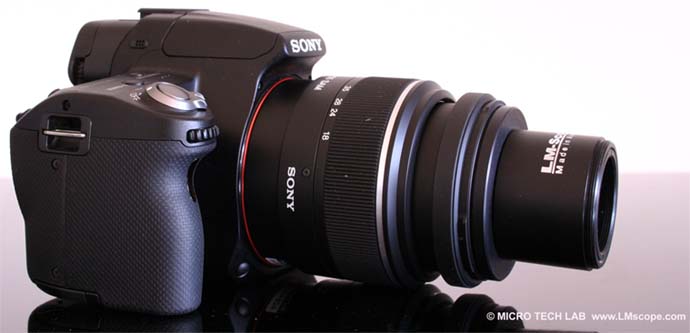
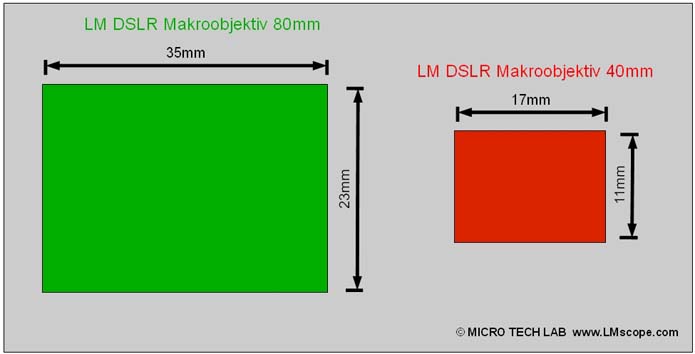
For our test series, we used the Kito lens 3.5-5.6/18-55 SAM. The LM Macros can be screwed onto the lens very quickly by using a step-down adapter (from 55 mm to 37 mm). The area between 35 mm to 55 mm is available for work and delivers first-class macro images with a high depth of field and vibrant colours. Below a zoom setting of 35 mm some peripheral darkening is visible. Due to the extremely strong close-up lens of 25 dioptres (LM Macro 40) it is possible to achieve a maximum magnification scale of 1.4:1. An area of 17 mm x 11 mm is depicted in full frame on the display. In the maximum zoom setting, we recommend using a macro stand (e.g. LM Macro Stand3) or at least a tripod.
If you work with the weaker LM Macro 80 with a refraction power of 12.5 dioptres, a larger image field (35 mm x 23 mm) is produced at the maximum zoom setting of the Kito lens 3.5-5.6/18-55 SAM. This corresponds to a magnification scale of 0.7:1. Due to the low weight of the LM Macro 80 – just 54 g – it is ideally suited for mobile applications. In addition, it is considerably more comfortable and powerful than a lens in retro position! The LM Close-Up lens is mounted without any complicated modifications being required as it only needs to be screwed into the filter thread. Even the automatic and zoom functions of the base object can still be used.
Field of View (FOV) 3,5-5,6/18-55 SAM and LM 40 and 80

29.11.2011
New LM Digital Adapter for: Sony Alpha 7R V / Sony Alpha 1 / Sony FX3 Cinema Line / Sony Alpha 9 II (ILCE-9M2) / Sony Alpha 9 / Sony Alpha 7R IV / Sony Alpha 7S II / Sony Alpha 7S III / Sony Alpha 7R III / Sony Alpha 7R II / Sony Alpha 7C / Sony Alpha 7S / Sony Alpha 7III / Sony Alpha 6700 / Sony Alpha 6600 / Sony Alpha 6400 / Sony Alpha 6100 / Sony ZV-E10 / Sony Alpha 6300 / Sony Alpha 6500 / Sony Alpha 99 II (SLT-A99 II) / Sony Alpha 77 II / Sony Alpha 7R / Sony Alpha 7 / Sony Alpha 68 / Sony Alpha 99 (SLT-A99) / Sony Alpha 7II / Sony Alpha 6000 / Sony Alpha 77V / Sony Alpha 580 / Sony Alpha 5100 / Sony Alpha 5000 / Sony Alpha 55 / Sony Alpha 33 / Sony Alpha 35 / Sony NEX-7 / Sony NEX-6 / Sony Alpha 57 / Sony Alpha 37 / Sony NEX-5N / Sony NEX-C3 / Sony NEX-F3 / Sony NEX-5 / Sony NEX-3 / Sony Alpha 65V / Sony Alpha 700 / Sony Alpha 850 / Sony Alpha 900 / Sony NEX VG10 / Sony Alpha 3000 / Sony Alpha 450 /