Digital Consumer cameras in microscopy


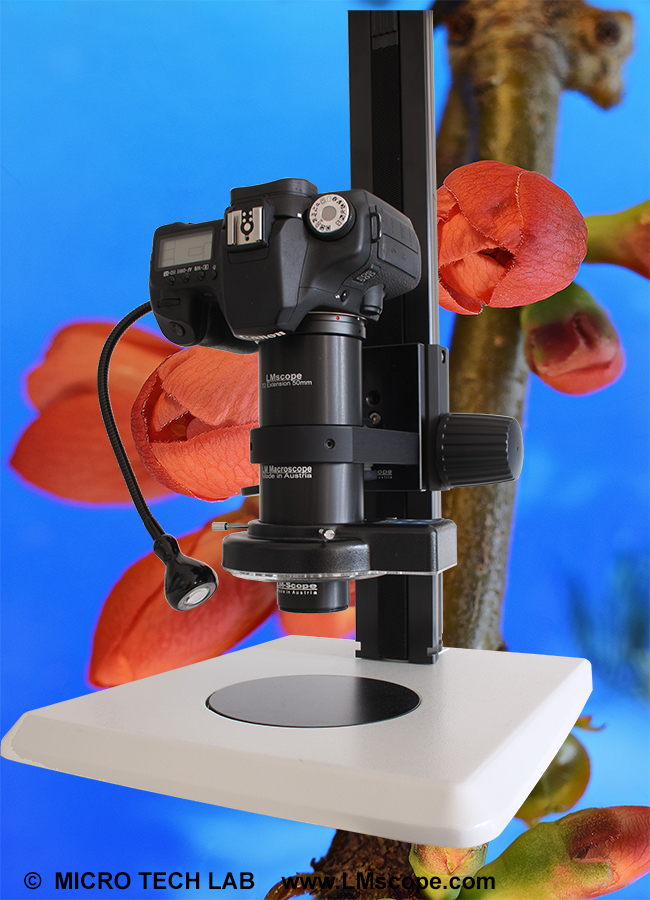
When using digital consumer cameras (e.g. Nikon Coolpix 4500/8700) in microscopy and in macro photography, the optical viewfinder cannot be used for controlling and adjusting the image. The magnified image is projected directly onto the CCD chip and can not be seen in the viewfinder (exception: Sony DSC-F717). The picture in the viewfinder does not correspond to the "real" image on the camera´s LCD control monitor.  The LCD monitor´s reduced image size (Nikon CP 8700:134.000 pixels) sometimes makes it difficult to find the perfect camera adjustment.

An external control monitor, connected via video cable, shows a higher resolution image  than the  LCD monitor and allows perfect focussing.
However, you can also focus by using the built-in LCD monitor: Zoom up the picture by digital zoom, adjust the sharpness and switch back to the initial position.

Due to the built-in zoom lens, some digital consumer cameras offer a certain zooming range: The biggest range is offered by Nikon Coolpix 9XX-4500 and Olympus Camedia 5060Z.

After adjusting the adjustments screw on the microscope and setting the camera to infinity, it is possible to use the camera´s autofocus .

Unlike the mechanical shutter, the electronic shutter avoids vibration.


Digital consumer cameras always show the picture on the built-in control LCD monitor.  The optical viewfinder is useless for microscopy for most digital consumer cameras (paralaxe).
A DSLR camera allows to look at the picture through the optical viewfinder; the built-in monitor shows only the taken picture after shooting.


Exception: The Sony DSC-F717 has a LCD color viewfinder with integrated LCD monitor with diopter compensation.


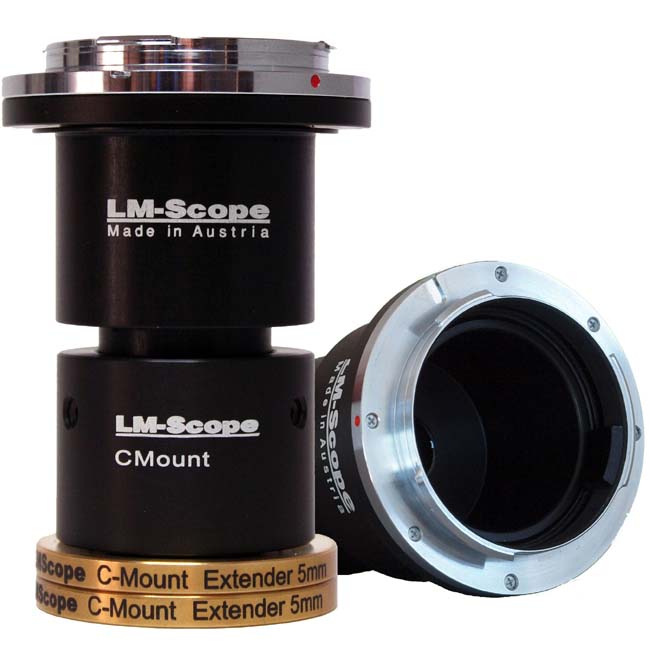
New LM Digital-Adapter for:
Canon EOS 1Ds Mark III / Nikon D3 / Nikon D300 / Olympus E-3 / Canon EOS 450D / Digital Rebel XSi / Canon EOS 1D Mark III / Sony Alpha 350 / Olympus E-330 / Olympus E-510 / Sony Alpha 300 / Olympus E-410 / Olympus E-520 / Panasonic Lumix DMC-L10 / Pentax K20D / Canon EOS 1Ds Mark II / Canon EOS 40D / Samsung GX-20 / Leica Digilux 3 / Canon EOS 5D / Sony Alpha 700 / Canon EOS 400D / Digital Rebel XTi / Olympus E-400 / Sigma SD14 / Canon EOS 30D / Kodak DCS Pro 14n / Kodak DCS Pro SLRc / Canon EOS 1D Mark II / Canon PowerShot S80 / Kodak DCS Pro SLRn / Canon EOS 20D / Canon EOS 20Da / Canon EOS 350D / Digital Rebel XT / Canon EOS 1D Mark II N / Fujifilm FinePix S5 Pro / Olympus C-7070 Wide Zoom / Nikon D2X / Canon EOS 10D / Canon EOS 300D / Digital Rebel / Nikon D200 / Olympus C-5060 Wide Zoom / Sigma SD9 / Pentax K10D / Sigma SD10 / Nikon Coolpix 4500 / Olympus E-300 / Nikon Coolpix 990 / Olympus E-500 / Nikon Coolpix 995 / Fujifilm FinePix S3 Pro / Nikon D2Xs / Nikon Coolpix P5100 /


Which digital camera functions best on a microscope?


High-end intermediate optics for the connection of digital camera and microscope


Turn your digital reflex camera into a microscope
Digital SLR cameras can now be converted into a microscope simply by screwing the LM DSLR macro lens  onto the existing lens.
LM DSLR macro lens 40mm / 80mm 


Tips and tricks for Digicams / Camcorders
Demo pictures taken with Digital Cameras and Camcorders


© 1999-2008 MICRO TECH LAB. All rights reserved

How to order
Contact
Home
 Newsletter