Use of Digital SLRs with CMOS Full Format Sensors in Microscopy

The Canon EOS 5D is the first affordable digital reflex camera with full format sensor. The body costs approx. EUR 2,700 (as of February 2006). Combined with the LM Digital Adapter it is perfectly suitable for use in microscopy. Colour reproduction and image detail fidelity is extraordinary. With the optional 12.8 megapixels WLAN adapter (WFT-E1) the Canon EOS 5D leaves nothing to be desired. The 2.0 High-Speed USB interface enables you to transmit data to your computer without delay.


Due to the larger sensor format the number of pixels of the EOS 5D has also increased which leads to better light absorption because of the larger pixel plane. As a result the signal-noise ratio and the image quality is much better at high ISO values. Low-noise and light-sensitive sensors are especially important when capturing images by using extremely light absorbing methods, such as, e.g., fluorescent microscopy or polarisation microscopy.


  The images displayed on the 2.5" LCD screen are sharply defined and rich in contrast.


Side view of the Canon EOS 5D: 2.0 High-Speed USB (Mini-B, PTP), video output (PAL/NTSC), port for remote control release (via N3 contact), output for external flash


In addition, with the software included in the delivery you can store the images directly on your computer hard disk. Therefor, the camera must be connected to the PC with a USB cable. Furthermore,  the mirror lock-up of the Canon EOS 5D must be activated. With this feature you can avoid fuzziness resulting from mirror vibrations.


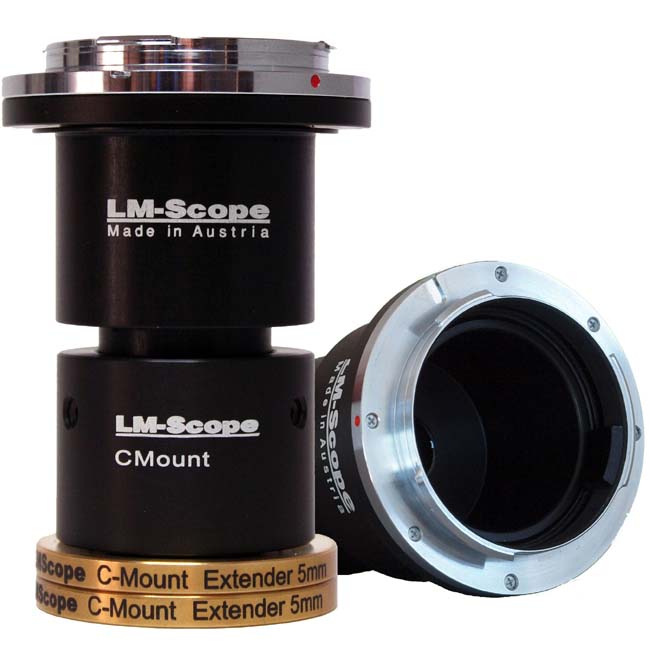
New LM Digital-Adapter for:
Canon EOS 1Ds Mark III / Nikon D3 / Nikon D300 / Olympus E-3 / Canon EOS 450D / Digital Rebel XSi / Canon EOS 1D Mark III / Sony Alpha 350 / Olympus E-330 / Olympus E-510 / Sony Alpha 300 / Olympus E-410 / Olympus E-520 / Panasonic Lumix DMC-L10 / Pentax K20D / Canon EOS 1Ds Mark II / Canon EOS 40D / Samsung GX-20 / Leica Digilux 3 / Canon EOS 5D / Sony Alpha 700 / Canon EOS 400D / Digital Rebel XTi / Olympus E-400 / Sigma SD14 / Canon EOS 30D / Kodak DCS Pro 14n / Kodak DCS Pro SLRc / Canon EOS 1D Mark II / Canon PowerShot S80 / Kodak DCS Pro SLRn / Canon EOS 20D / Canon EOS 20Da / Canon EOS 350D / Digital Rebel XT / Canon EOS 1D Mark II N / Fujifilm FinePix S5 Pro / Olympus C-7070 Wide Zoom / Nikon D2X / Canon EOS 10D / Canon EOS 300D / Digital Rebel / Nikon D200 / Olympus C-5060 Wide Zoom / Sigma SD9 / Pentax K10D / Sigma SD10 / Nikon Coolpix 4500 / Olympus E-300 / Nikon Coolpix 990 / Olympus E-500 / Nikon Coolpix 995 / Fujifilm FinePix S3 Pro / Nikon D2Xs / Nikon Coolpix P5100 /


Which digital camera functions best on a microscope?


High-end intermediate optics for the connection of digital camera and microscope


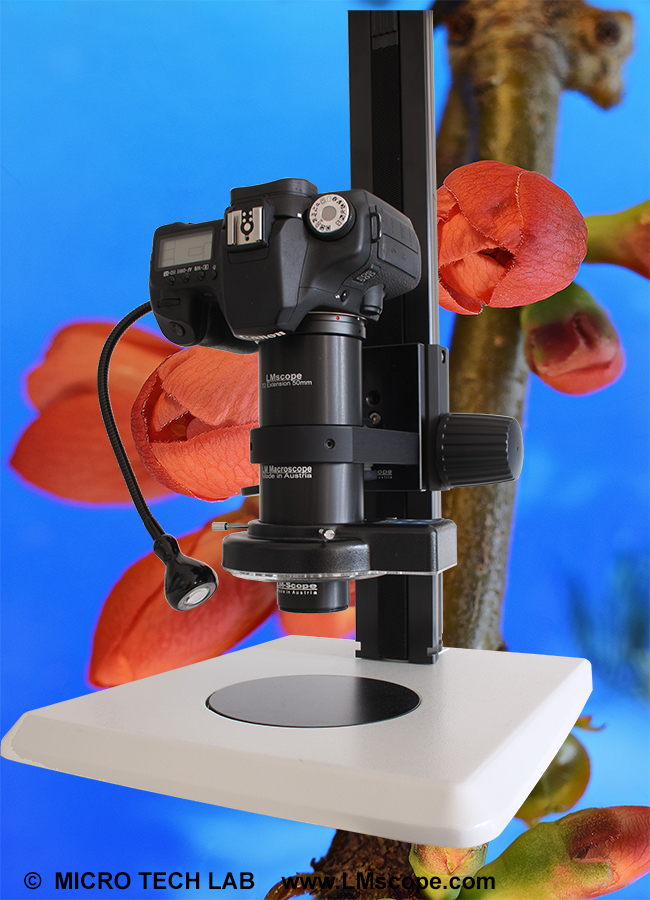
Turn your digital reflex camera into a microscope
Digital SLR cameras can now be converted into a microscope simply by screwing the LM DSLR macro lens  onto the existing lens.
LM DSLR macro lens 40mm / 80mm 


Tips and tricks for Digicams / Camcorders
Demo pictures taken with Digital Cameras and Camcorders


© 1999-2008 MICRO TECH LAB. All rights reserved

How to order
Contact
Home
 Newsletter